Archives: all-projects

all-projects werden im Portfolio angezeigt.

Circular Neighbourhood

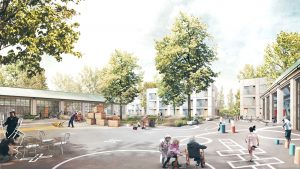
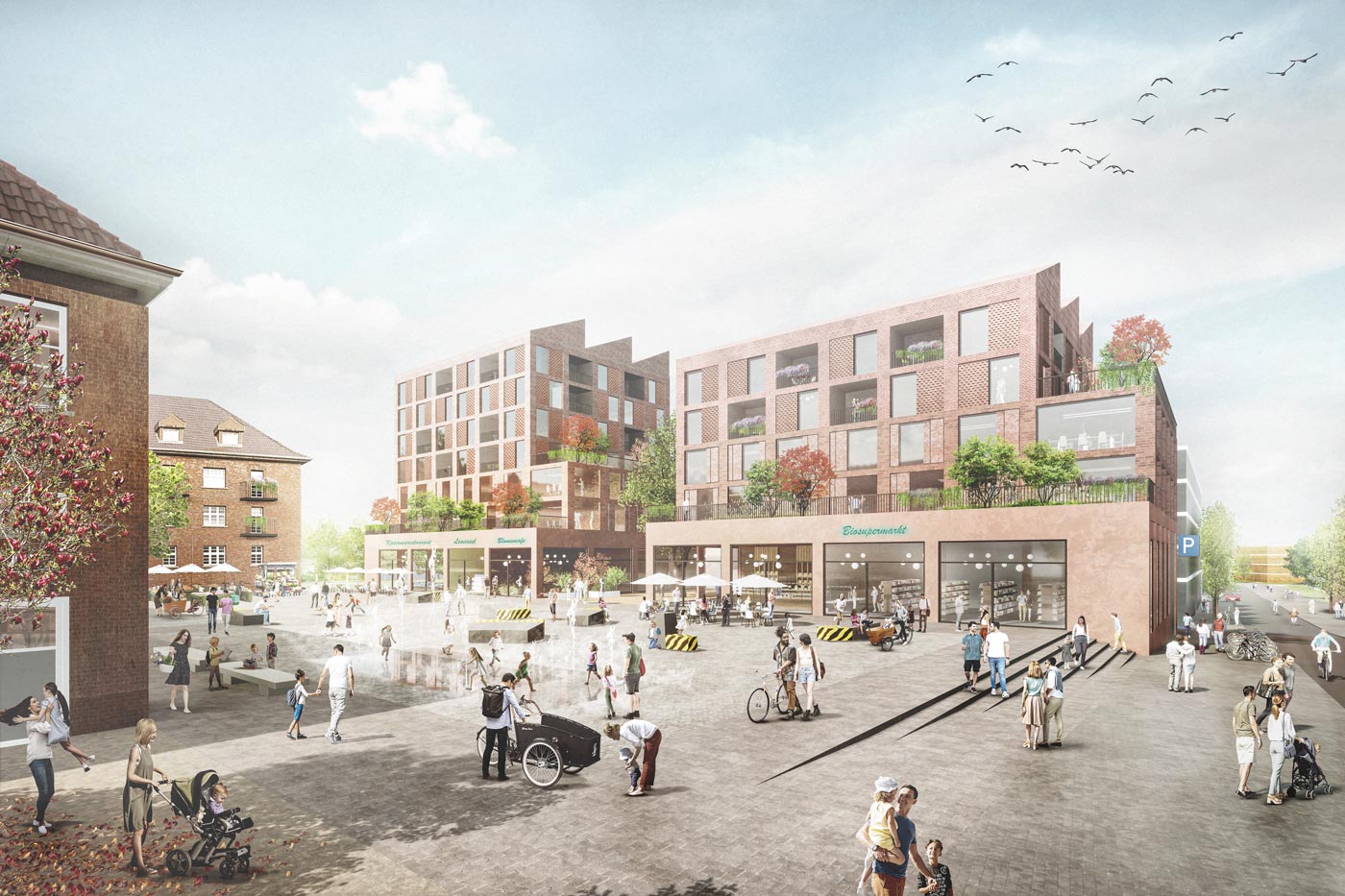
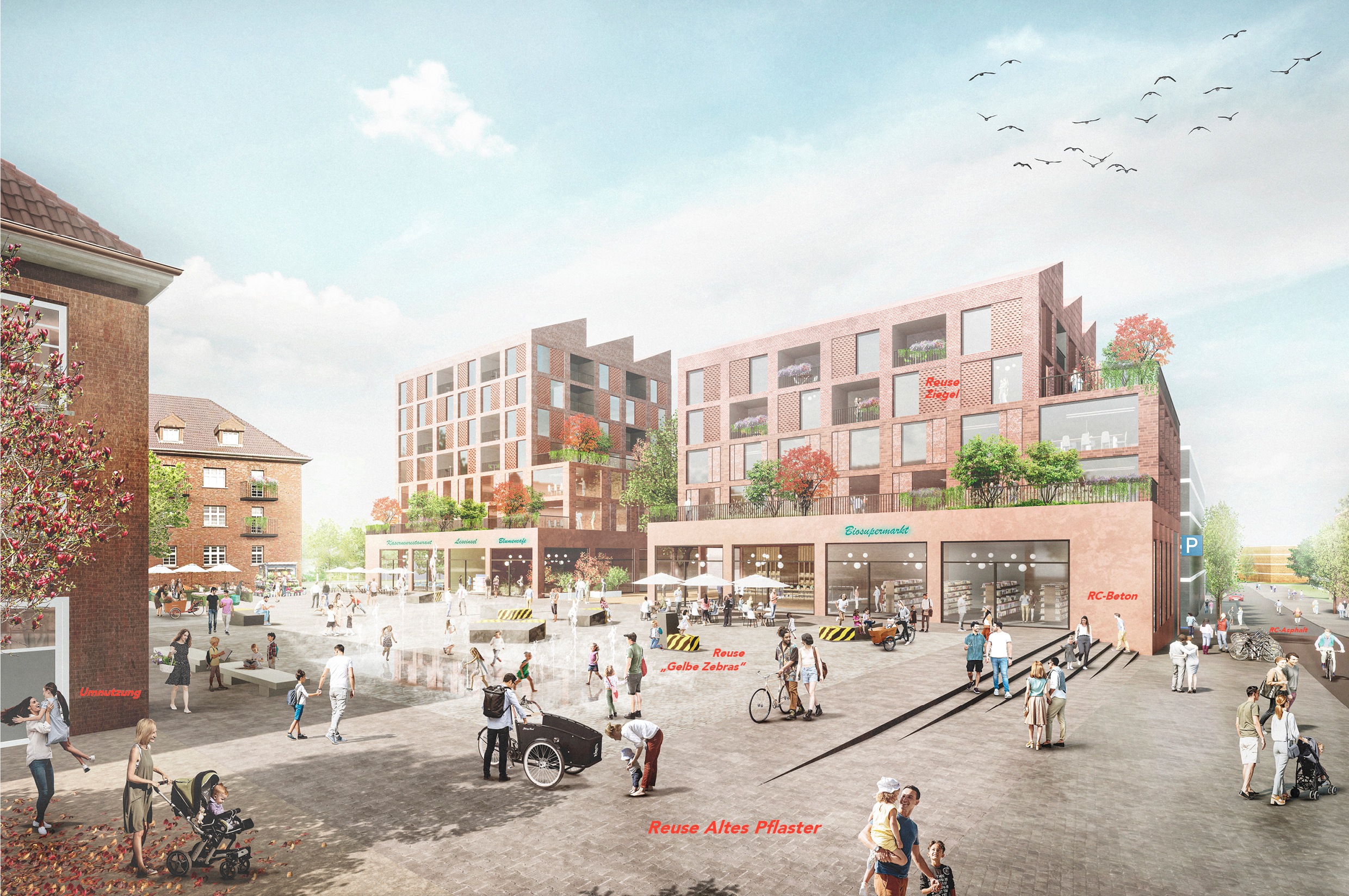
A multiple strategy of adaptation, unsealing, rebuilding, reuse, completion of new buildings pays tribute to the existing structure as an urban mine and is the starting point for an integrated and sustainable development. Existing buildings and elements of open space are material resources that not only shape the character in the new neighbourhood, but also address the concern for the existing fabric and foster sustainability through circular design. This subject finds expression in an open and simple urban figure with interconnecting pathways.
SSG-Rochdale-Platz-mitText

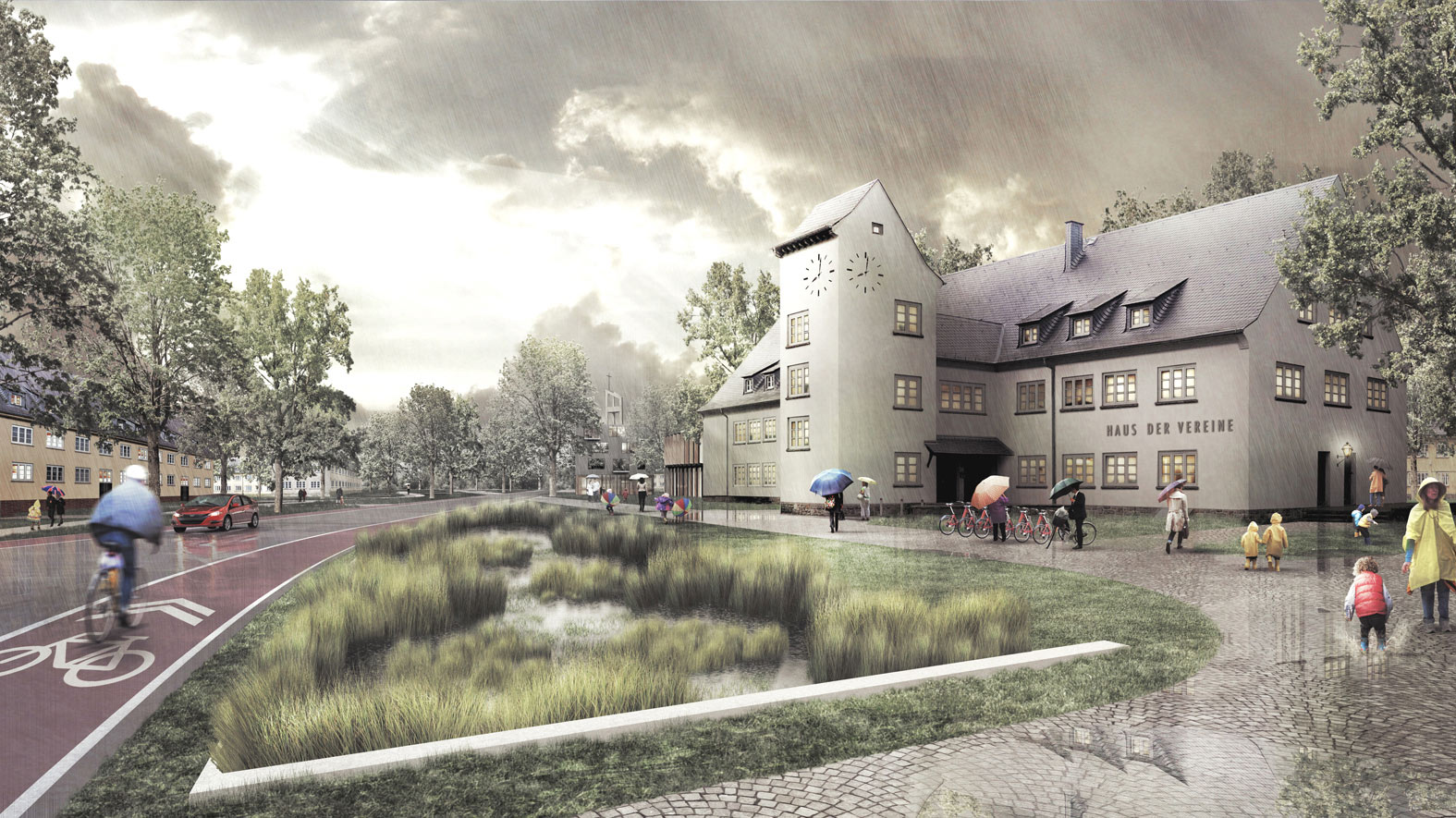
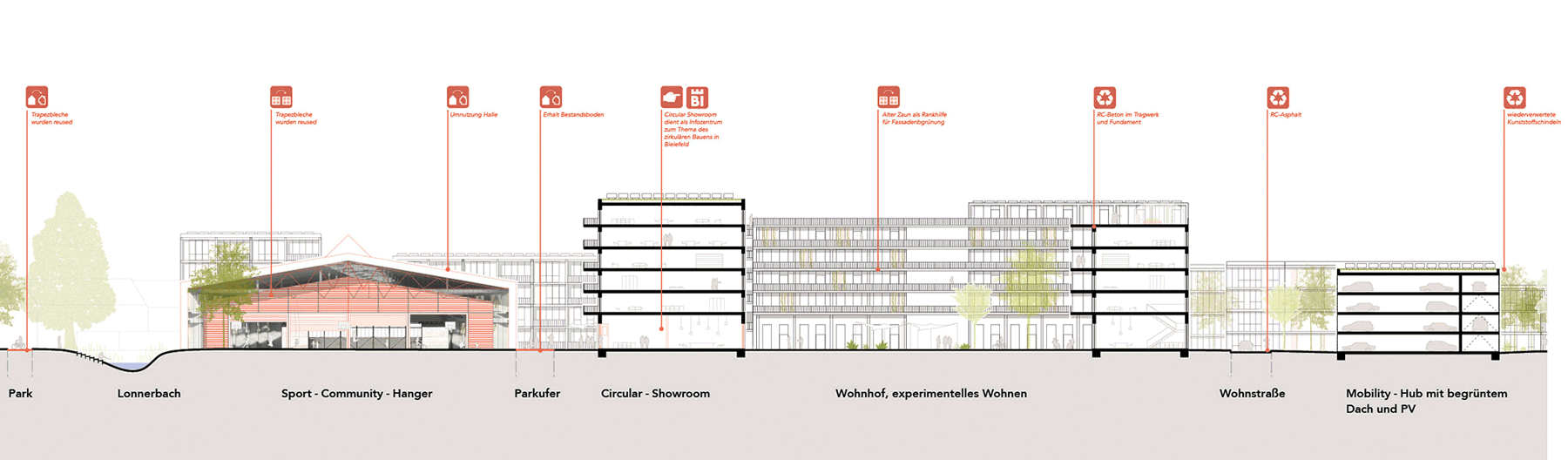
The conversion of urban barracks in an inner-city area offers special opportunities for a resource-sensitive urban transformation. The extensive building stock is a space and material resource and opens up the possibility of closed recycling loops. In terms of resource management, the preservation of the existing buildings has priority. The urban structure is chosen in such a way that usable existing buildings can be reused beyond the specifications of the competition. Those that cannot be used are selectively dismantled in order to reuse or recycle materials.

This is made possible by process-oriented planning and a related set of rules that lays the foundation for circular construction: The materials are recorded at an early stage through a reuse assessment and made available to the planning with their quantities and qualities in a material market for local use and recycling.

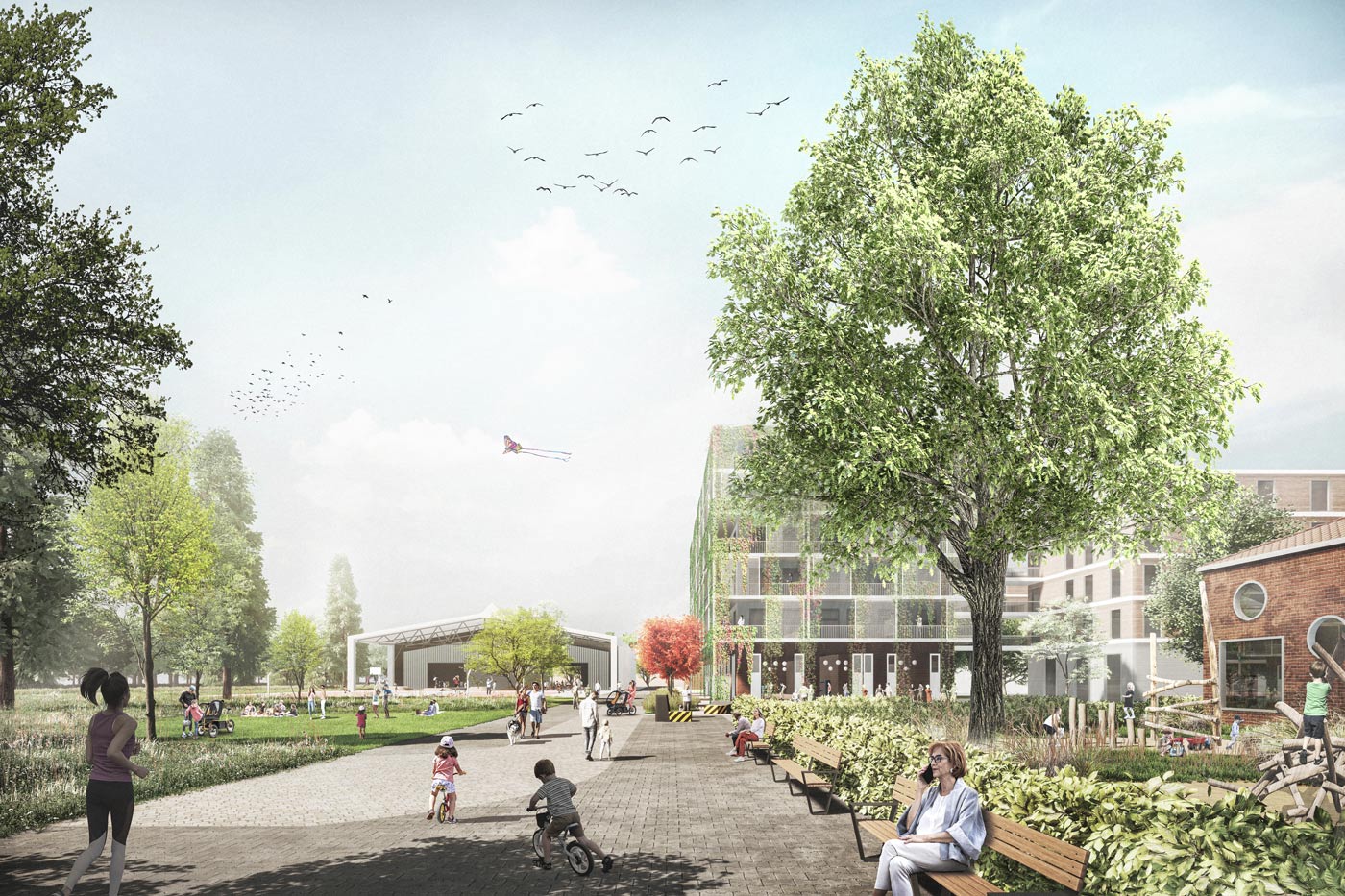
The Circular Neighbourhood can show what is possible through its model character. Circular processes can be communicated and conveyed in the circular showroom. It creates a new and old context in the form of reused structures and materials with patina, which can not only shape the character in the new quarter, but also promotes circular building in its formation and operation.


Urban planning realisation competition (1st price) and implementation


Programme: Mixed and experimental Neighbourhood, 11 ha

Location: Bielefeld, DE

Year: 2021-2024

Client: City of Bielefeld

Team: Therese Granberg, Joachim Schultz-Granberg, Daniel Heuermann, Augusta Verbiesen

Partner: bbz landscape architects berlin, Concular, A.Calitz Visual


SSG-Rochdale-Kreisläufe-1600

SSG-Rochdale-Lageplan-1400


SSG-Rochdale-Gliederung

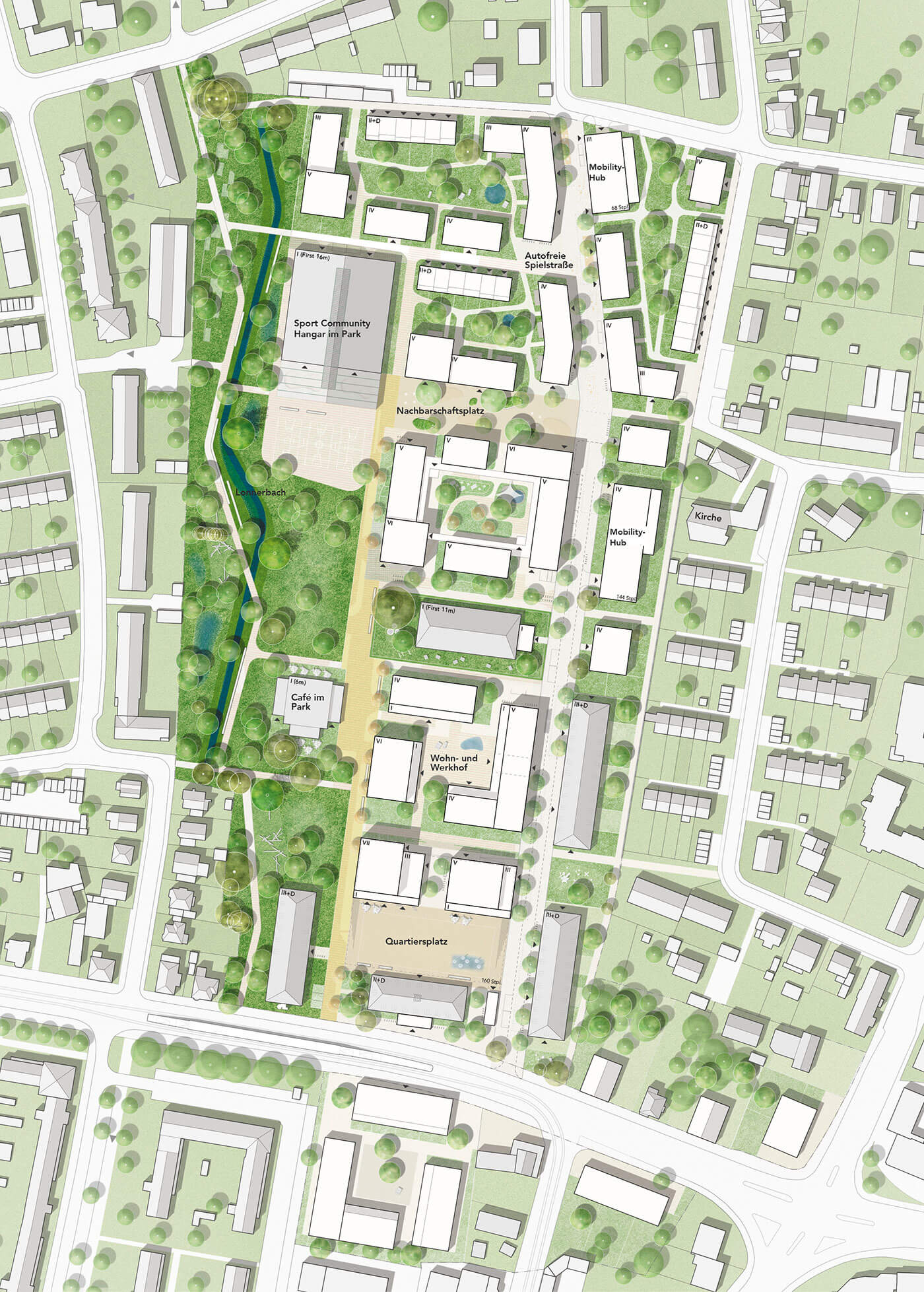
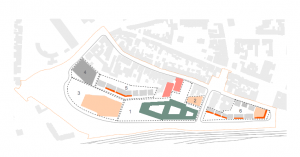
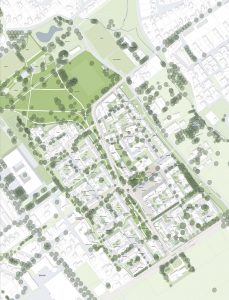
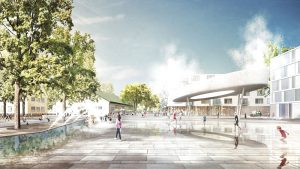
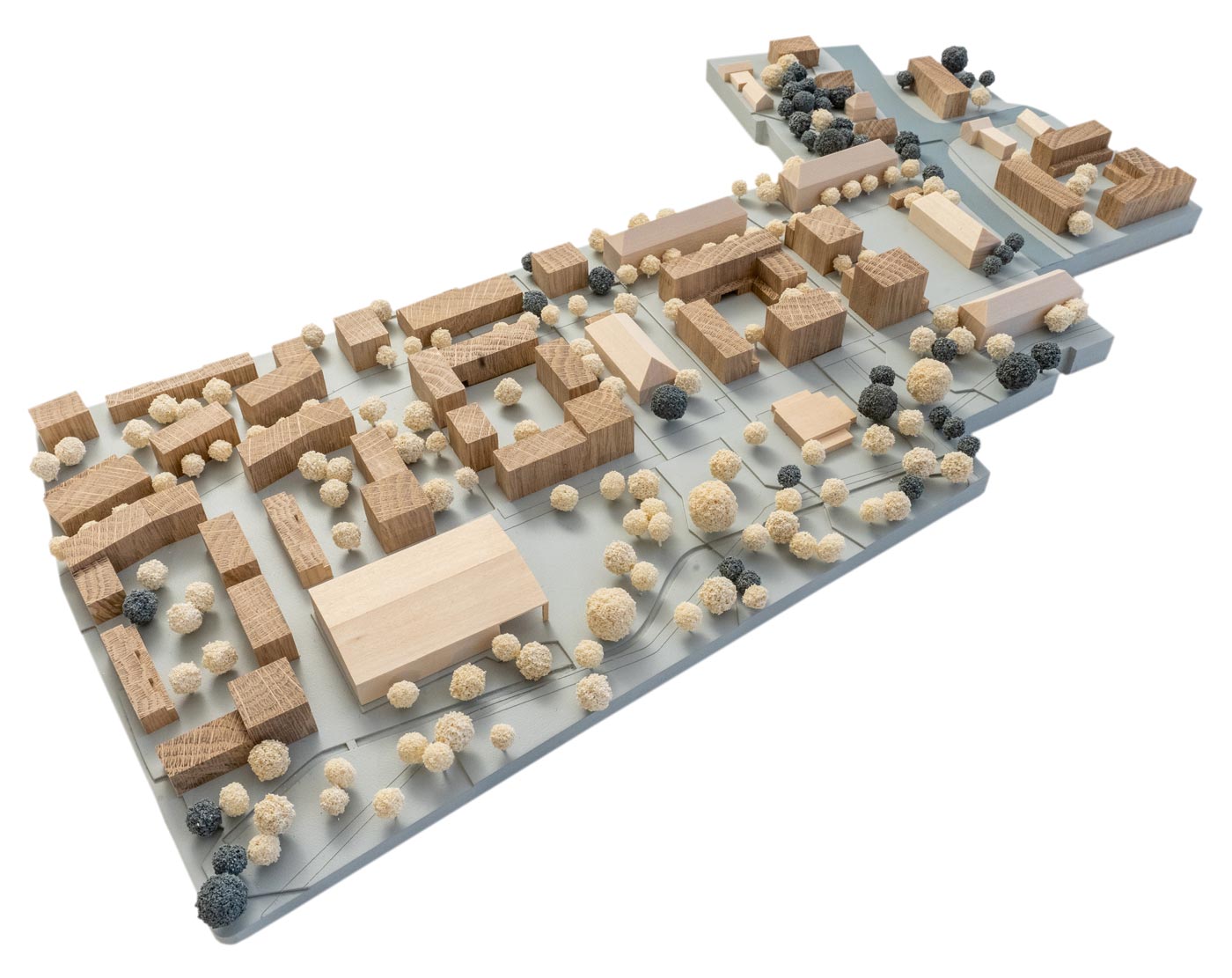
The opening up of the Rochdale barracks offers the opportunity for a connection of the surrounding neighbourhoods. Former rearsides become forefronts and new interfaces offer valuable spaces for new and old residents. All existing pathways will be taken up by the urban structure and streets will continue to be used. The structure of the area is determined by the position of the entrances in the south:

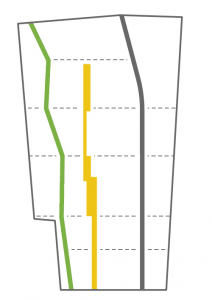
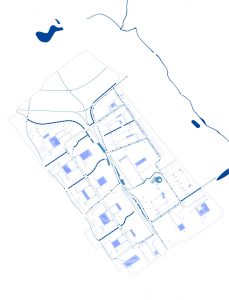
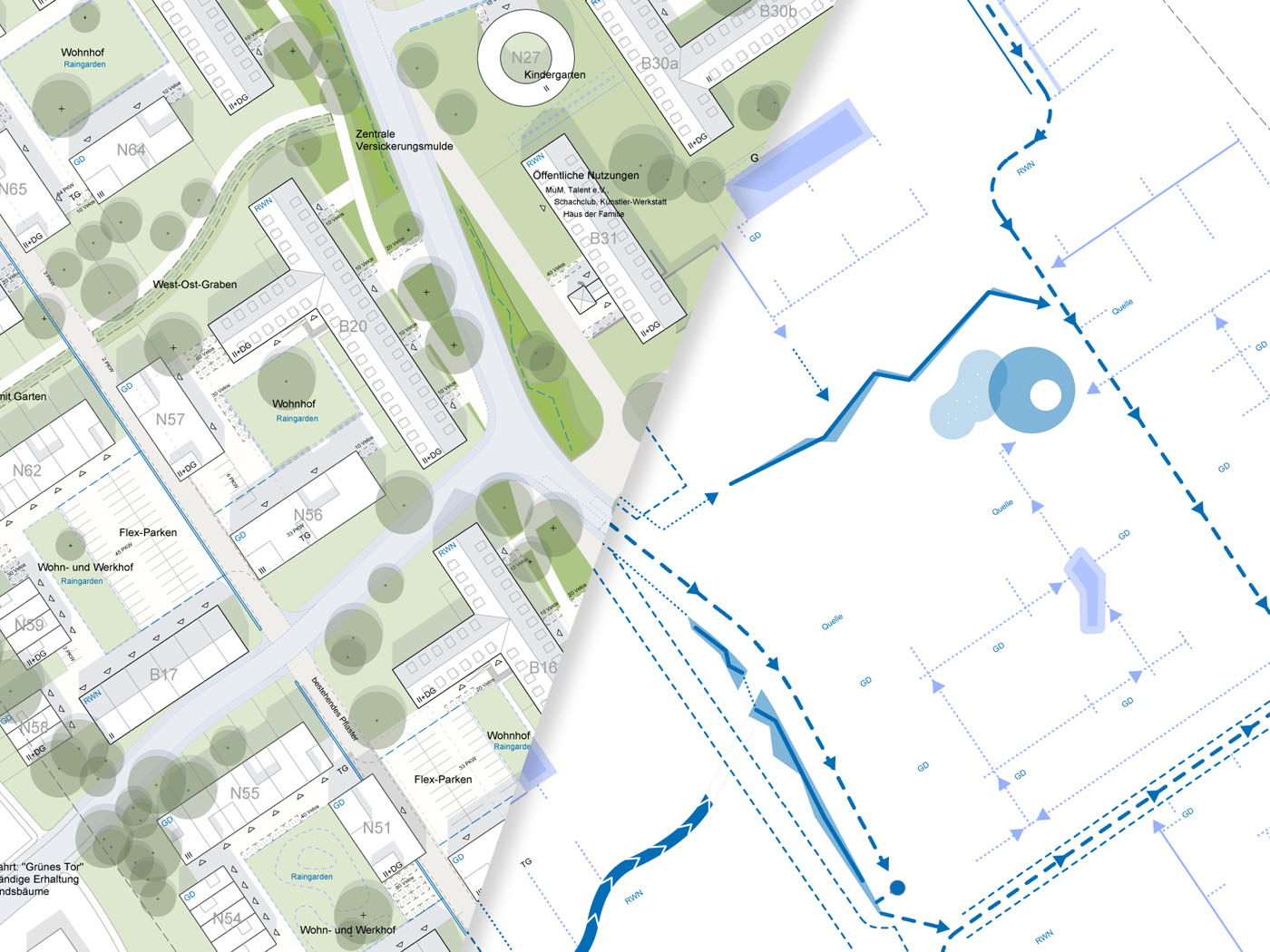
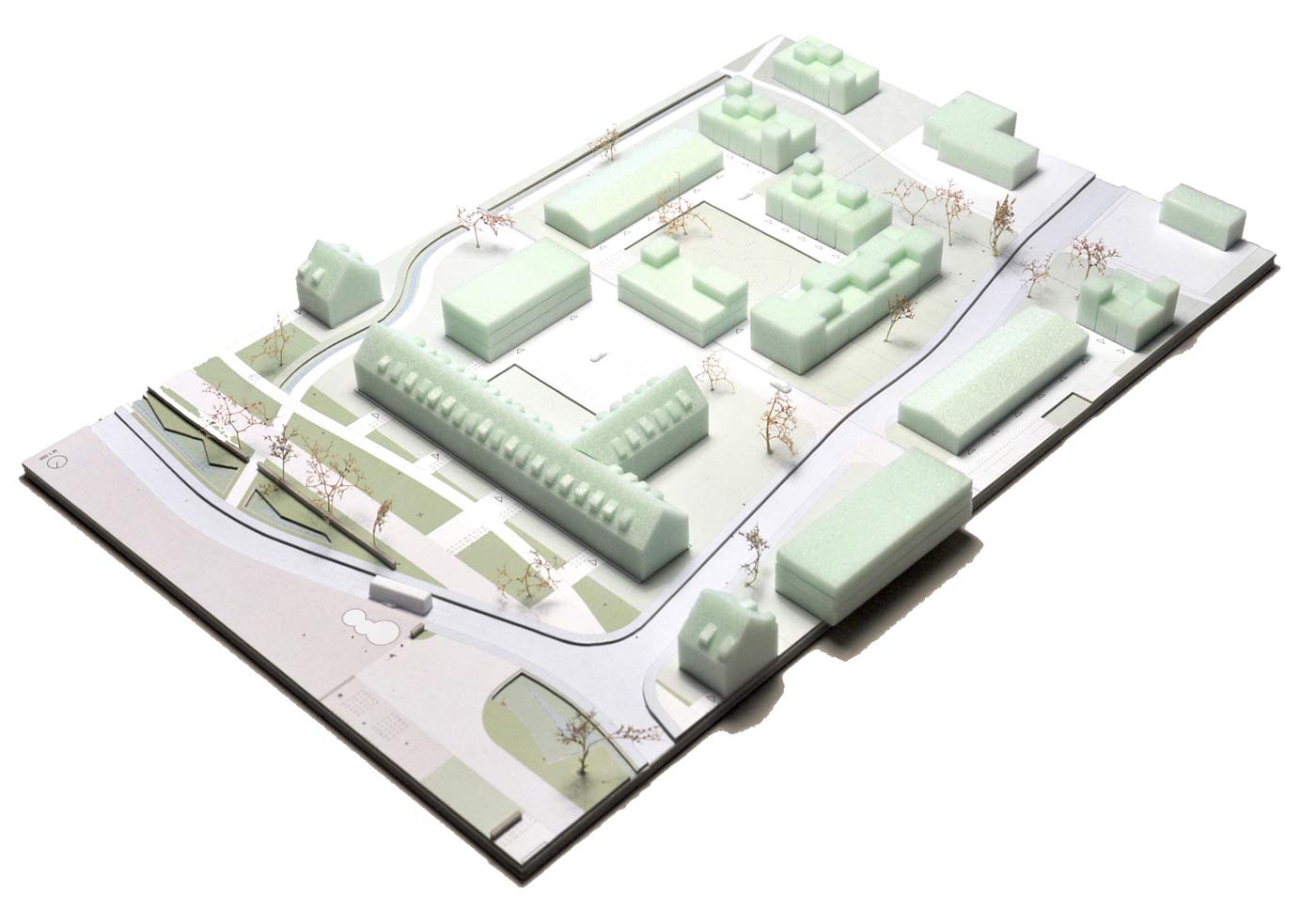
Three differently characterised lines divide the area in a north-south direction: 1) The traffic-calmed residential street in the east provides access to the decentrally located mobility hubs. 2) A slightly swinging path leads through the park in the west. 3) The interface between the park and the building sites is marked by the “shore”, a boulevard for pedestrians and cyclists. Cross-connections link up with existing and potential paths and streets and, together with the three lines, form a robust basic structure with clearly cut building plots.
 

SSG-Rochdale-Modell-1400

SSG-Rochdale-Querschnitt


SSG-Rochdale-Ufer-1400

related projects
Oxford Barracks
Neue Schöne Hohe Häuser [New Beautiful High Buildings]

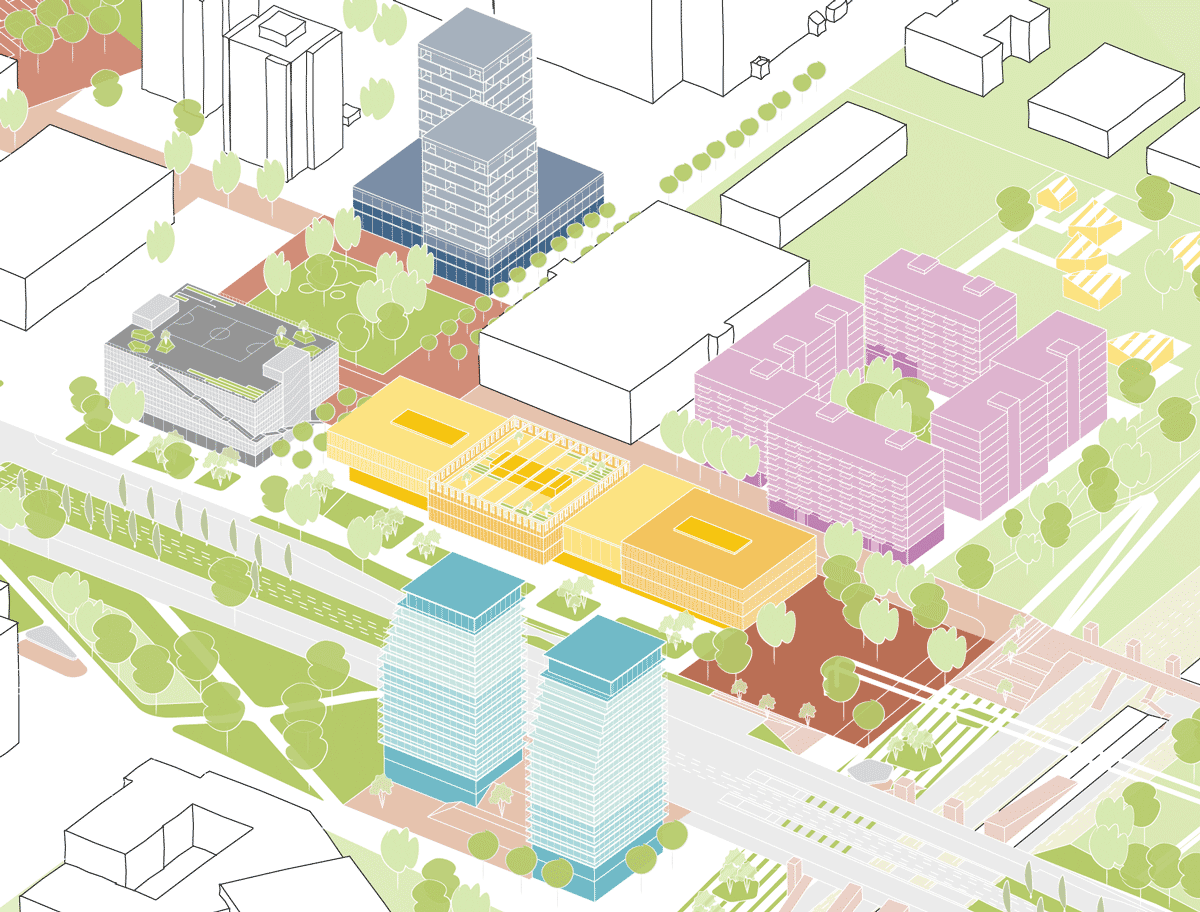
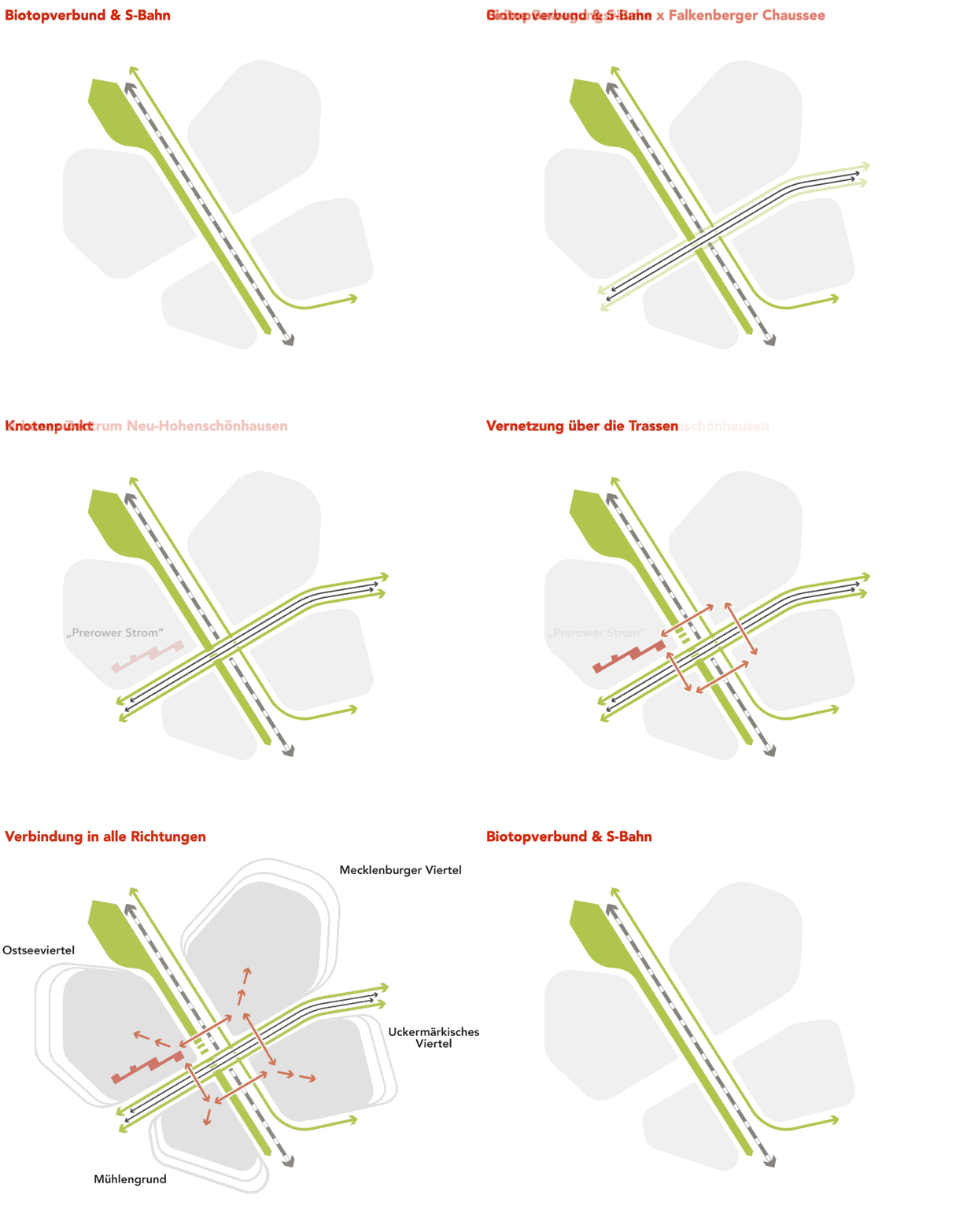
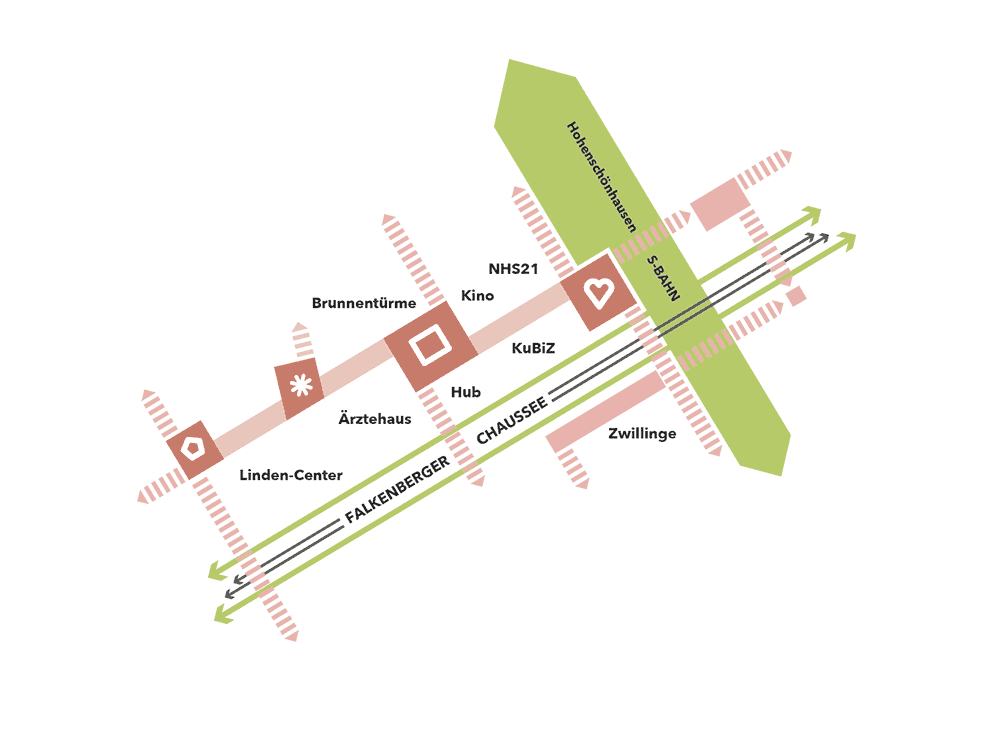
Die Komplettierung und Bereicherung bestehender Zentrumsfunktionen erfolgt als lineares urbanes Band vor allem nördlich der Falkenberger Chaussee. Die entstehende Platzfolge bildet das Rückgrat des Urbanen Zentrums Neu-Hohenschönhausen. Als öffentlicher und lebendiger Bewegungsraum, vernetzt es alte und neue Adressen und bündelt öffentliche Funktionen, Einzelhandel, Dienstleistungen, Büro- und Wohnnutzungen sowie das Mobility Hub. Die S-Bahnstation wird als zentraler Knotenpunkt gestärkt. Hier kreuzt das lineare Zentrum den übergeordneten Biotopverbund. Alle umliegenden vier – durch diesen Kreuzungspunkt unterteilten – Bereiche Neu-Hohenschönhausens lassen sich schnell erreichen.

SSG-Wettbewerb-NeuHohenschoenhausen-Diagramm-Konzept-cr


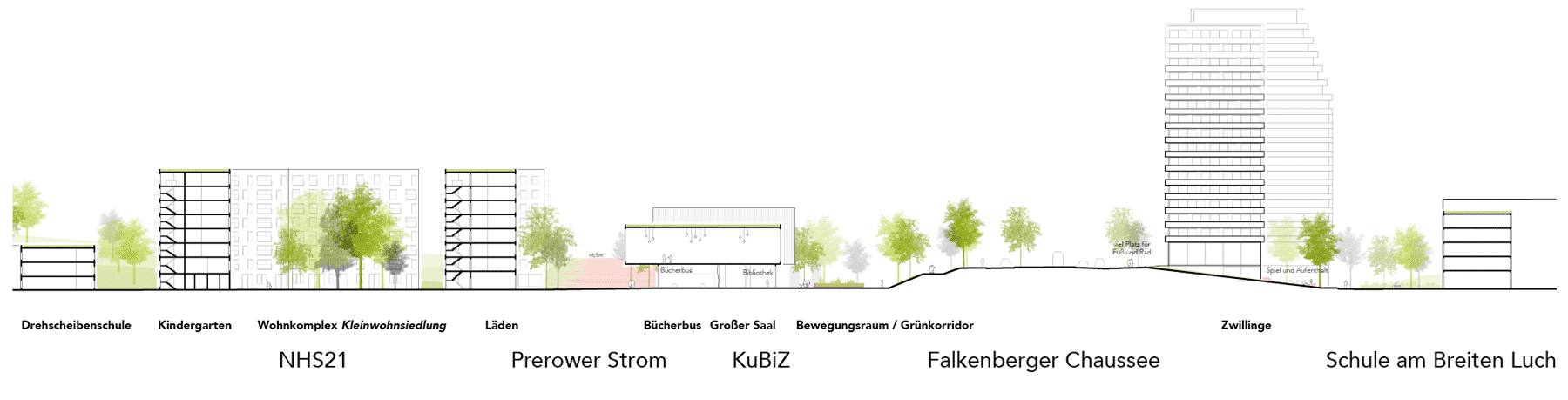
Die heute überdimensionierte Falkenberger Chaussee wird im Entwurf zu einem vernetzenden Grünkorridor qualifiziert und gewinnt Qualität mit viel Platz für den Fuß- und Radverkehr. Die straßenbegleitenden Grünräume bilden Bewegungs- und Aufenthaltsräume, die als Mischung aus Freiraum und Wegenetz eine zielgerichtete Verbindung für den übergeordneten Biotopverbund entlang der S-Bahn mit der Malchower Aue werden.


Zweiphasiger städtebaulicher Realisierungswettbewerb, 2. Preis


Programm: 80.000 qm BGF Nutzungsmix, 6 ha Realisierungsteil, 20 ha Ideenteil

Standort: Hohenschönhausen, Berlin-Lichtenberg, DE

Jahr: 2021

Ausloberin: Stadt Berlin, Bezirksamt Lichtenberg von Berlin

Team: Therese Granberg, Joachim Schultz-Granberg, Daniel Heuermann, Anna Nötzel

Partner: bbz landschaft berlin


Neu-Hohenschoenhausen-Axonometrie

SSG-Wettbewerb-NeuHohenschoenhausen-Diagramm-Strom

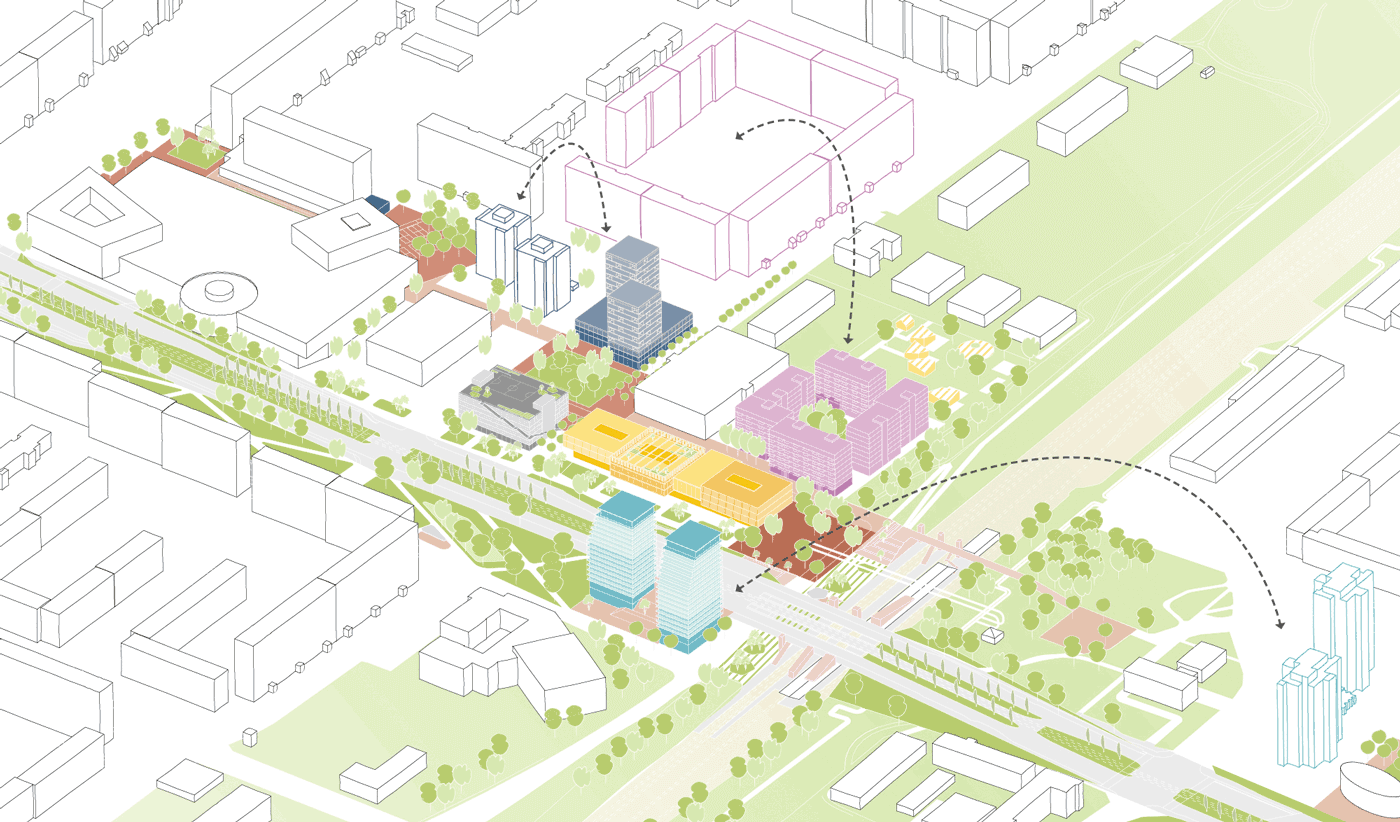
Die Platzfolge – der Prerower Strom (in Anlehnung an den Prerower Strom auf dem Fischland Darß) – verbindet Bewegungsströme und knüpft an die Grünräume an. Bestehende Freiräume und Zentrumsfunktionen werden aktiviert und ergänzt.

Die Baukörper nehmen vielfältige Nutzungen auf: Neben Wohn-, Gewerbe- und Büronutzungen, ist das Kultur- und Bildungszentrum (KuBiZ) als öffentlicher Baustein mit Bibliothek und vielen weiteren publikumswirksamen Nutzungen das zentrale bauliche Signet im öffentlichen Raum. Zwei Hochpunkte – die Zwillinge – komplettieren das urbane Zentrum südlich der Falkenberger Chaussee und vernetzen in diese Richtung.


SSG-Wettbewerb-NeuHohenschoenhausen-typologische-kopplung


SSG-Wettbewerb-NeuHohenschoenhausen-schnitt02Schnitt durch die Falkenberger Chaussee, Blick nach Nordosten
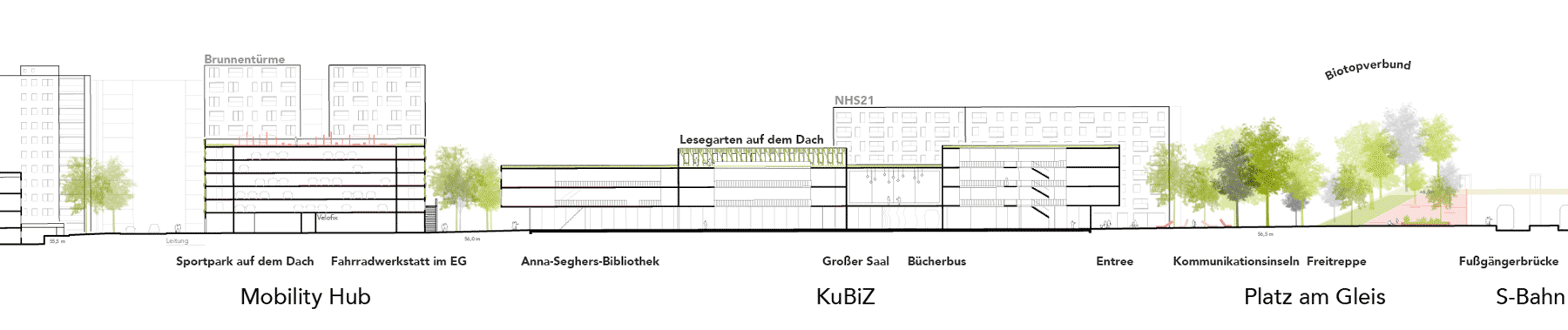


SSG-Wettbewerb-NeuHohenschoenhausen-Schnitt01Schnitt durch das Kultur und Bildungszentrum (KuBiZ) mit direktem Zugang zur S-Bahn
 

verwandte Projekte
Fabulous Halemweg


Open Mind

[english version in progress] “Wir schaffen gemeinsam ein neues Stück Stadt im Herzen der Aachener Altstadt. Ein Parkhaus blockiert seit Jahrzehnten die Entwicklung der Altstadt. Wir reißen es ab und bauen ein neues Quartier. Die Stadtgesellschaft selbst entwickelt Programm, Städtebau und Investitionsstrategie.” – Studio Schultz Granberg war eingeladen die städtebauliche Strategie für das Szenario Wissen in gemischten Teams mit der Stadtverwaltung und gemeinsam in einer Planungswerkstatt mit der Stadtgesellschaft zu erarbeiten.

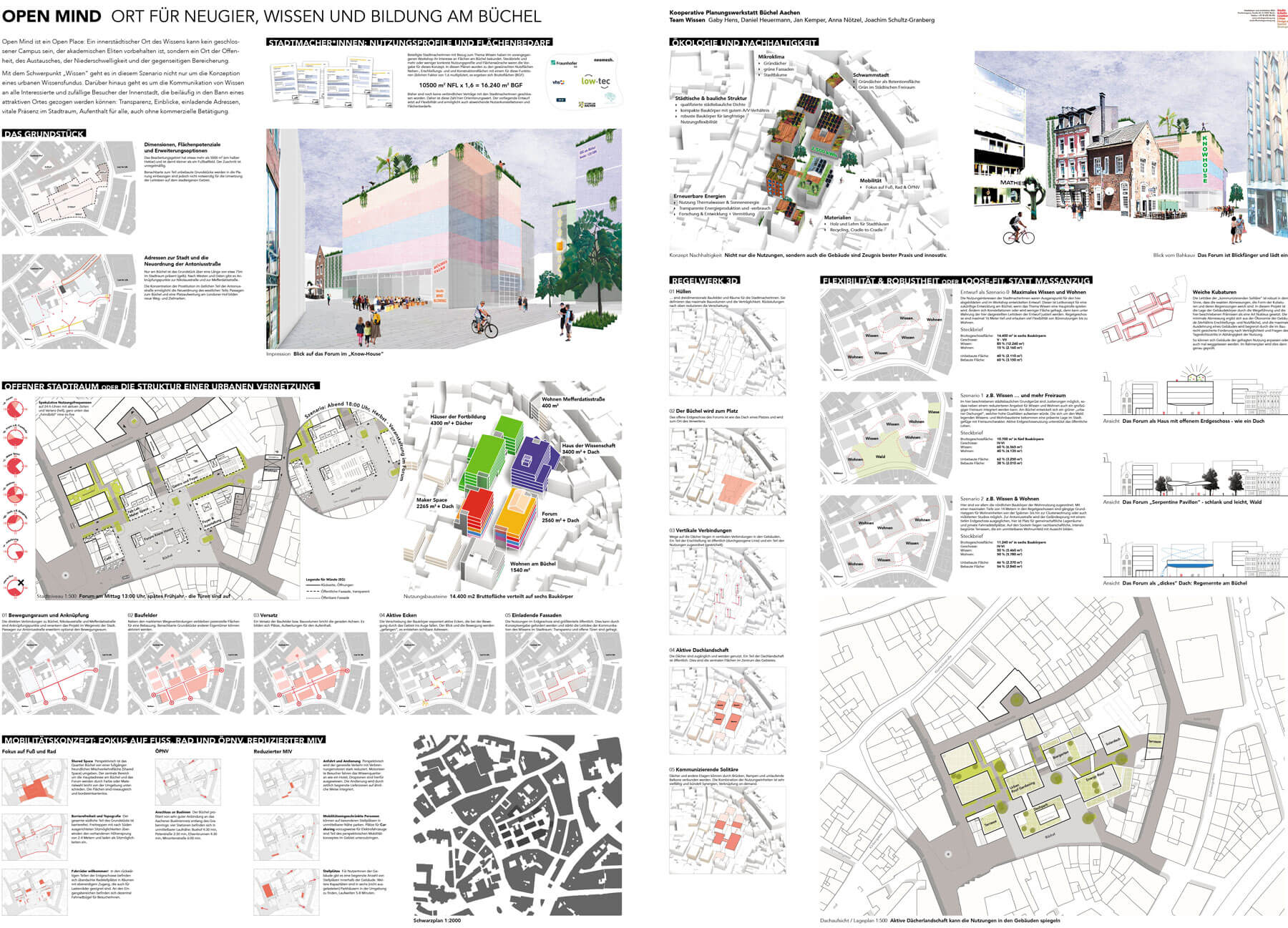
Open Mind ist ein Open Place: Ein innerstädtischer Ort des Wissens kann kein geschlossener Campus sein, der akademischen Eliten vorbehalten ist, sondern ein Ort der Offenheit, des Austausches, der Niederschwelligkeit und der gegenseitigen Bereicherung. Mit dem Schwerpunkt „Wissen“ geht es in diesem Szenario um die Konzeption eines urbanen Wissensfundus und darüber hinaus um die Kommunikation von Wissen an alle Interessierte und zufällige Besucher der Innenstadt, die beiläufig in den Bann eines attraktiven Ortes gezogen werden können: Transparenz, Einblicke, einladende Adressen, vitale Präsenz im Stadtraum, Aufenthalt für alle, auch ohne kommerzielle Betätigung.

Mit den Leitthemen Wissen, Wohnen und Wiese wurden in diesem kooperativen Verfahren potenzielle Entwicklungsrichtungen ausgelotet, die der Stadt Aachen als Entscheidungsgrundlage dienten. Im Anschluss an die städtebauliche Werkstatt entschied sich die Politik für die Weiterentwicklung des Gebietes als Wiese – Grünraum für die Innenstadt.


Kooperative Planungswerkstatt


Programm: Offenes Wissensquartier, 5000 qm

Standort: Aachen, DE

Jahr: 2021

Auftraggeberin: Stadt Aachen

Team: Joachim Schultz-Granberg, Daniel Heuermann, Anna Nötzel

Partner: Gaby Hens, Jan Kemper (MitarbeitInnen der Stadt Aachen)


SSG-Buechel-Panels-web-1800

verwandte Projekte
Werkstatt Fabulous Halemweg


ClusterLOG

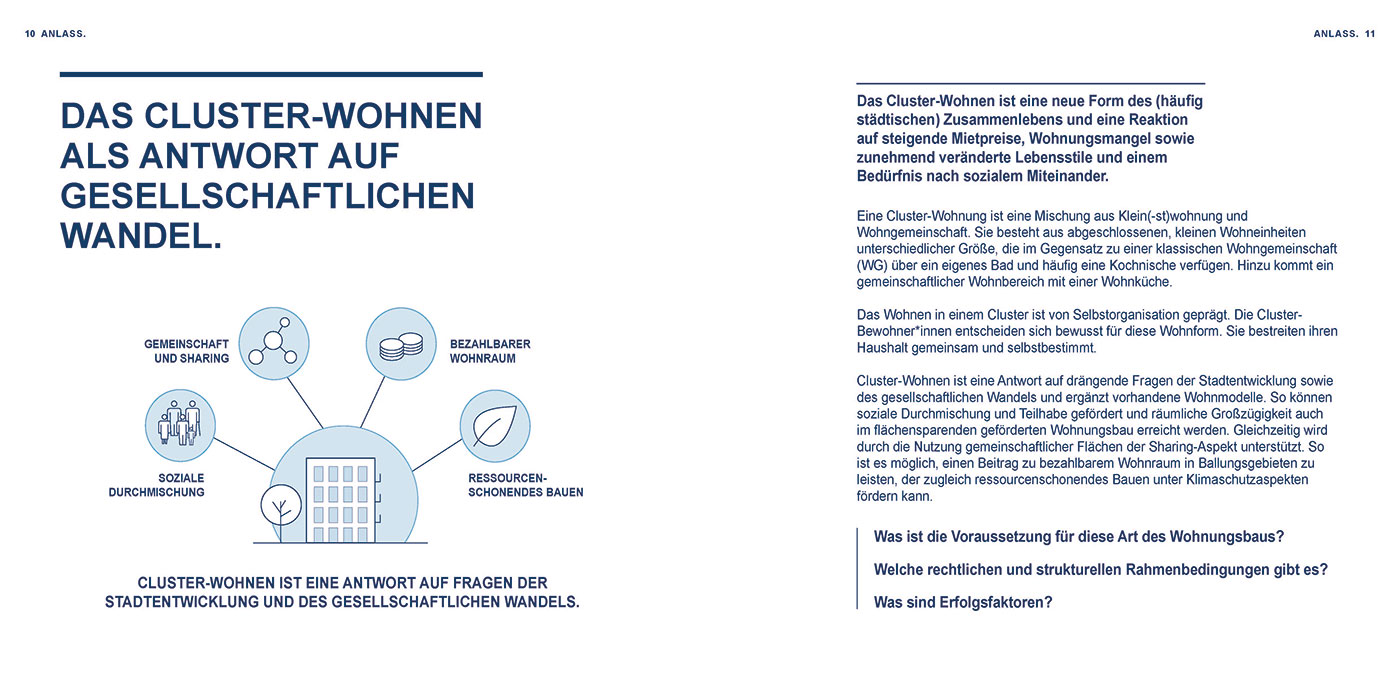
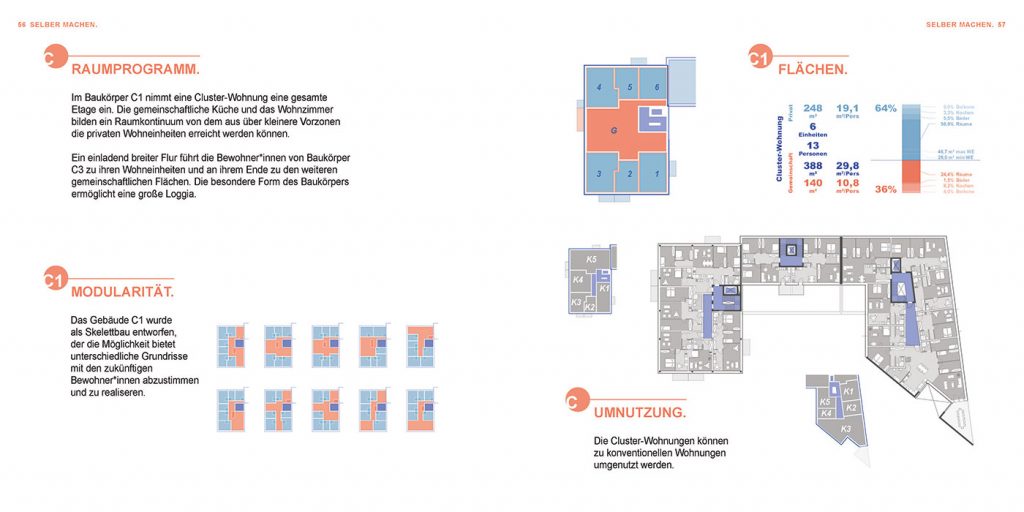
Increasing processes of individualization within society and the related differentiation of patterns of living and housing contribute to a pluralization of housing demands. Commissioned by the Housing Association Berlin-Mitte (WBM), cluster housing is investigated within this study as a shared form of housing. A handbook serves to integrate it into the association’s portfolio. Prototypical layouts were developed for a cooperative form of development oriented on the common good for the Haus der Statistik.

With the handbook ClusterLOG the Housing Association Berlin-Mitte expands the selection of housing options in Berlin for people who are looking for self-determined community living and dwelling. This strategy is a response to increased demand and intended to offer people of different age categories and of different walks of life a new form of affordable housing and living together.

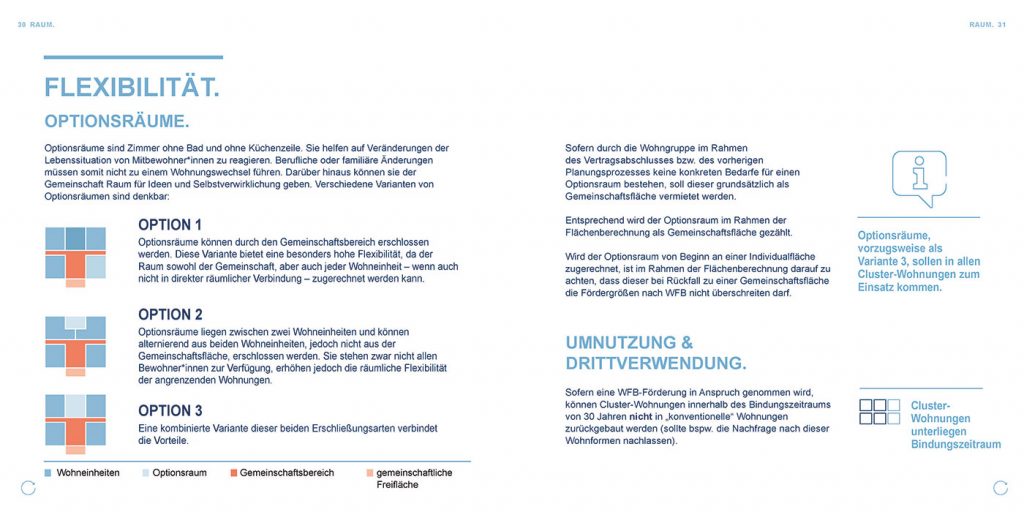
Independent residential units of different sizes are combined with communal spaces. This provides people with a form of affordable housing that differs from what is typically offered on the market.

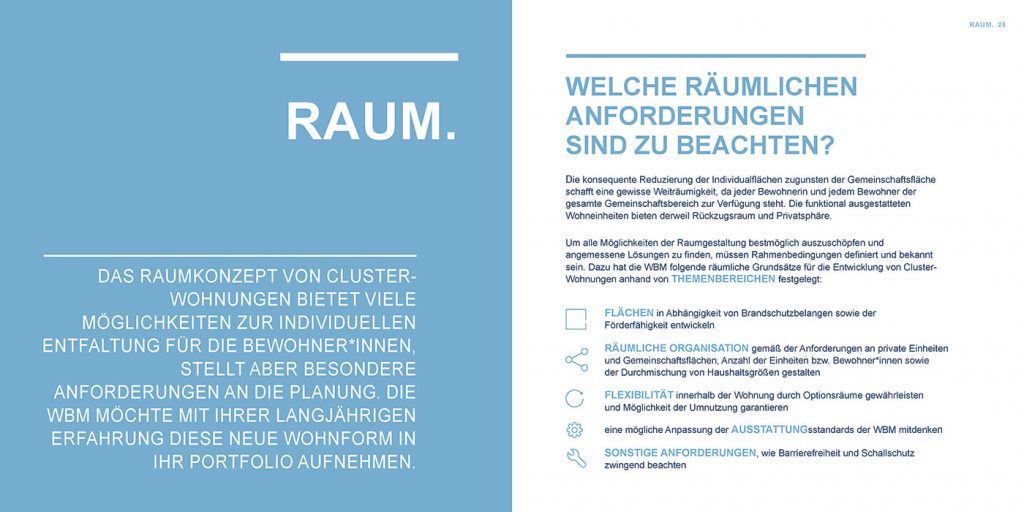
The generous communal areas are unique to this type of housing. Research on how lessons learned from pioneering projects can be applied to the Berlin context allow the identification and adjustment of individual parameters relevant to subsidized housing. Based on this research recommendations were formulated and substantiated by discussions with external experts. The results are presented in the ClusterLOG. The developed priciples were tested in designs for current projects of the WBM in the chapter “Selber machen” (DIY).

The study can be downloaded on the webseite of the WBM.

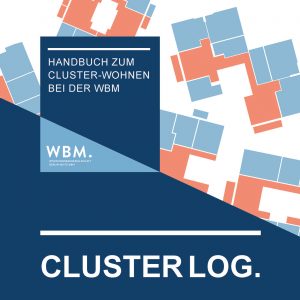
Deckblatt der Studie ClusterLOG


Expert Survey


Program: Manual for Cluster-Housing

Year: 2020

Client WBM Housing association Berlin-Mitte mbH

Team: Joachim Schultz-Granberg, Therese Granberg, Daniel Heuermann

Partner: Stadtbox


Village Centre Paulinenaue

Perspektive des Angers in der Neuen Mitte Paulinenaue

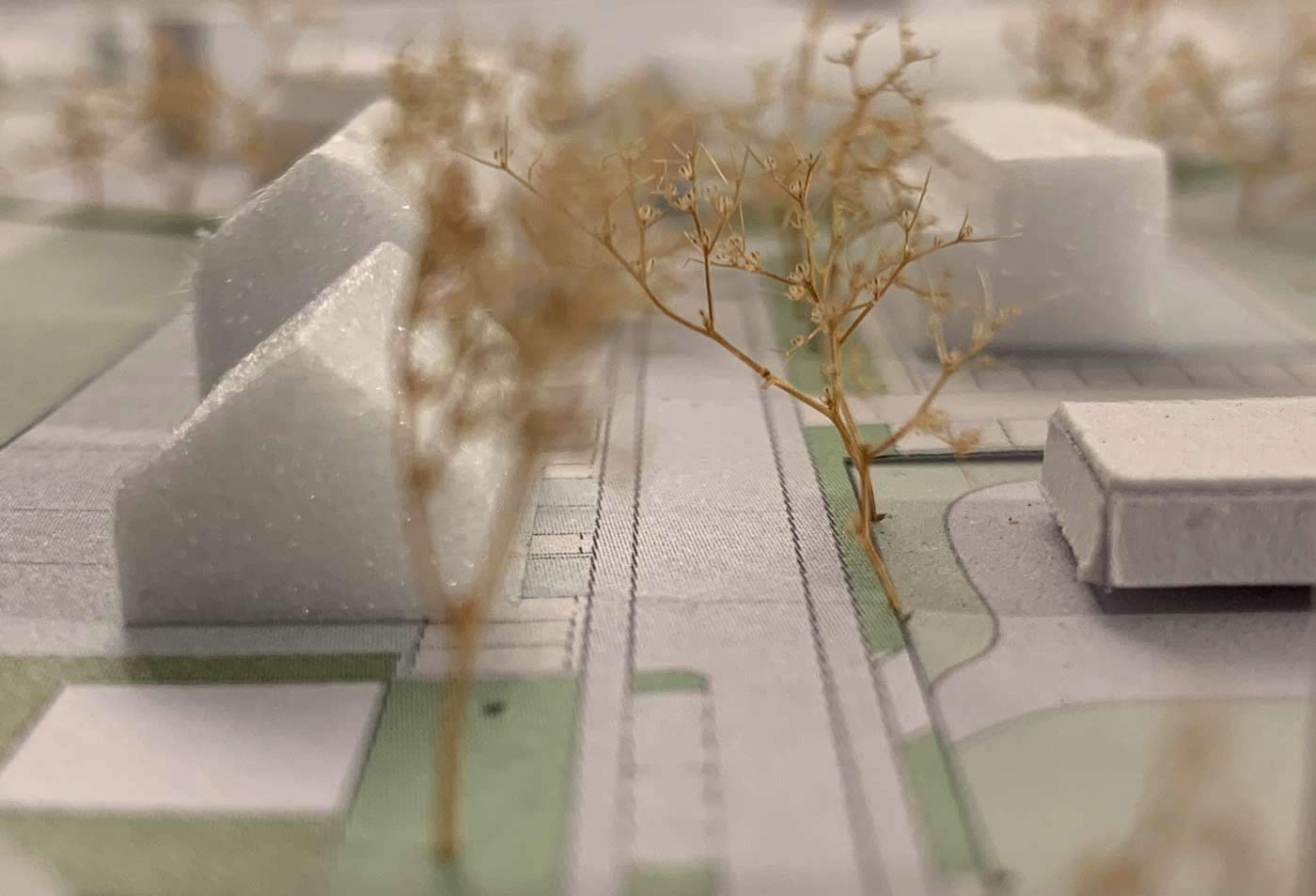
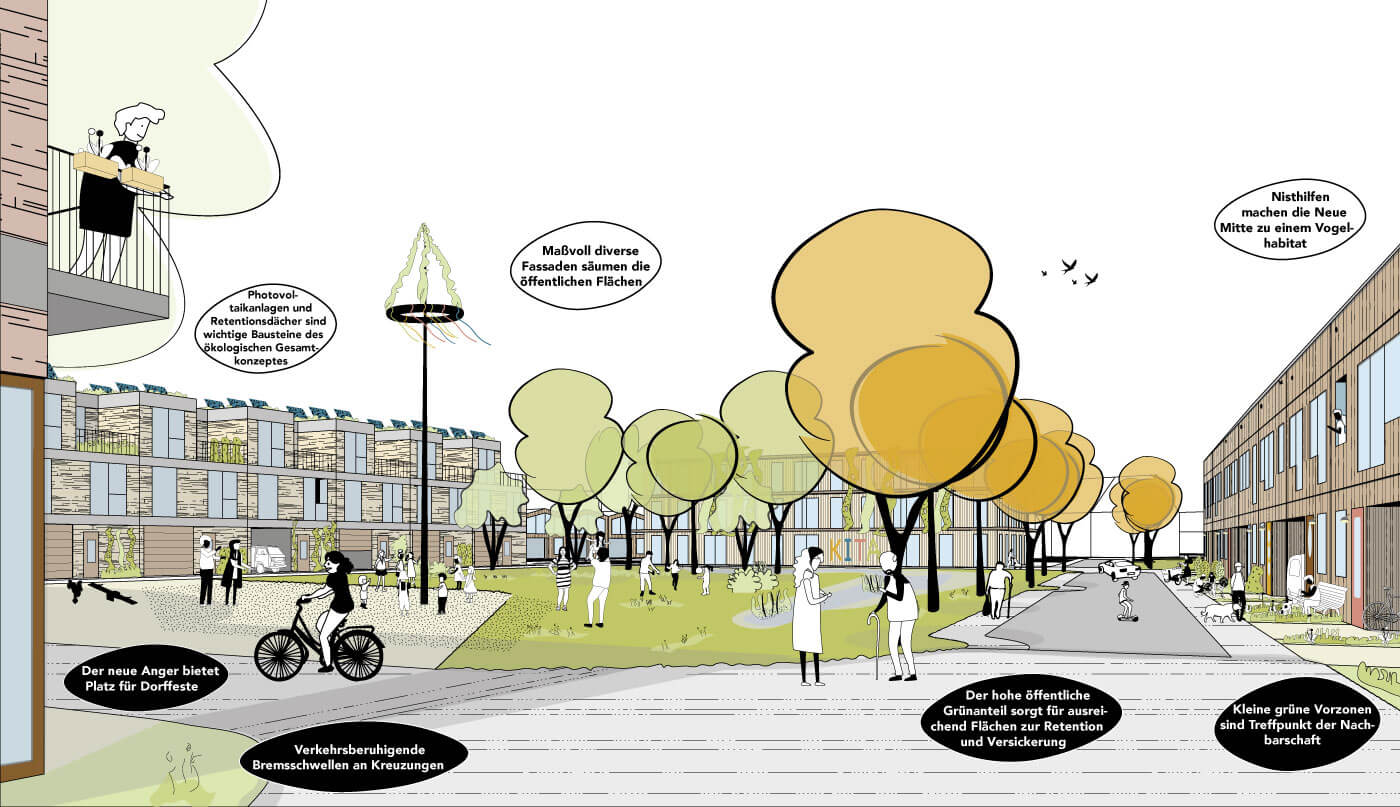
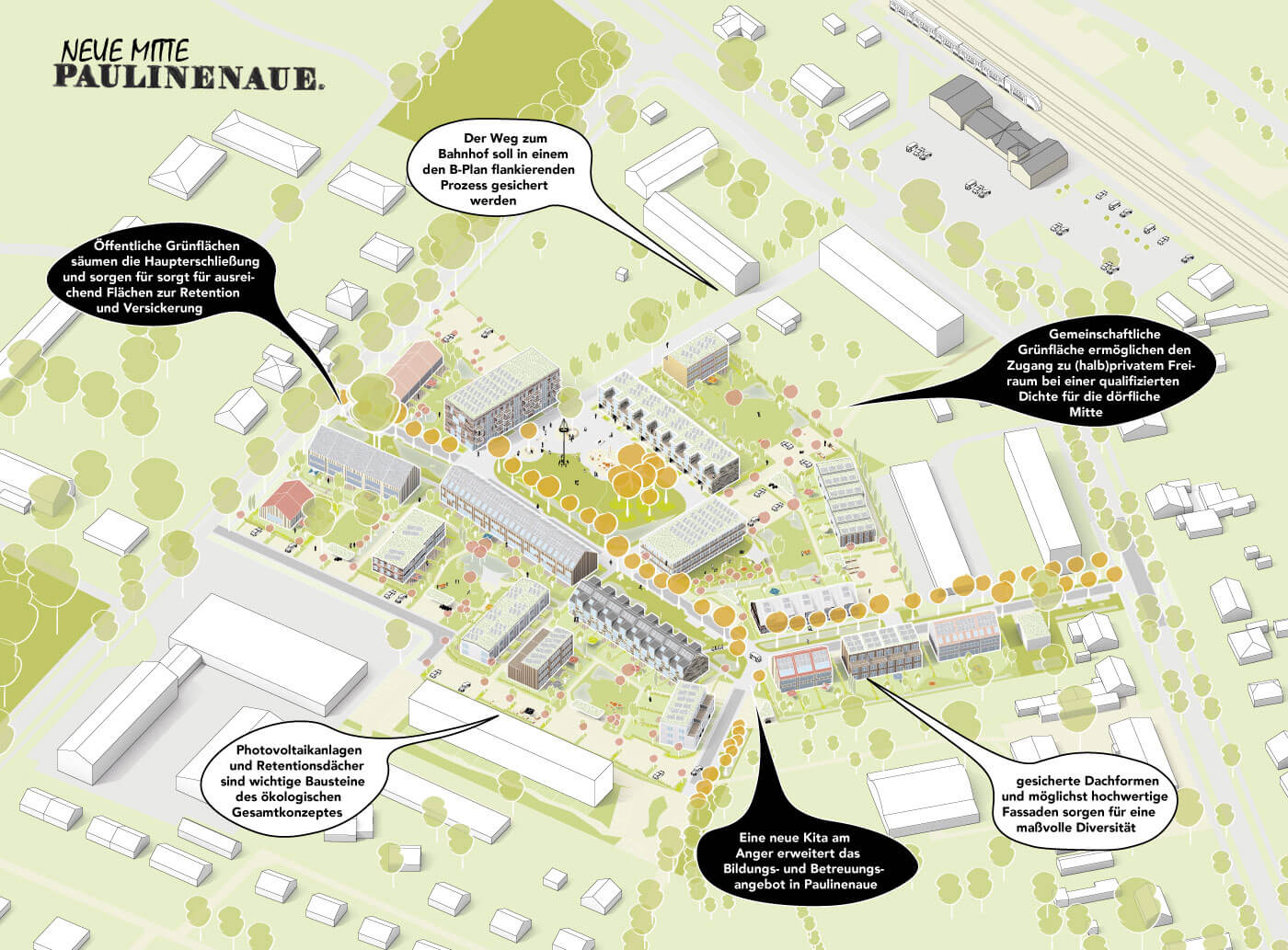
The village of Paulinenaue is located in the west of Berlin, just under an hour by train from the city center. In the immediate vicinity of the regional train station, a partially fallow area is being converted into a residential neighborhood and, with a high proportion of public green spaces, forms the new center of the village. Different dense typologies offer variety and housing models with and without gardens. The urban fabric forms courtyards and offers generous spaces for the neighborhood.

GIF der Herleitung der Struktur zur Neuen Mitte Paulinenaue


Urban Design and Zoning


Programme: Village Centre with 110 dwellings, 3 ha

Location: Paulinenaue, Federal State of Brandenburg DE

Year: 2019-2022

Client: S IMMO Germany

Team: Joachim Schultz-Granberg, Therese Granberg, Daniel Heuermann

Partners: Jörg Siegmüller (kklf), Hoffmann-Leichter Ingenieure, Hagen Rossmann Landschaft


Axonometrie Neue Mitte Paulinenaue

Rahmenplan Neue Mitte Paulinenaue


related projects:
(Sub)urban Mix Lippstadt

Fabulous Halemweg

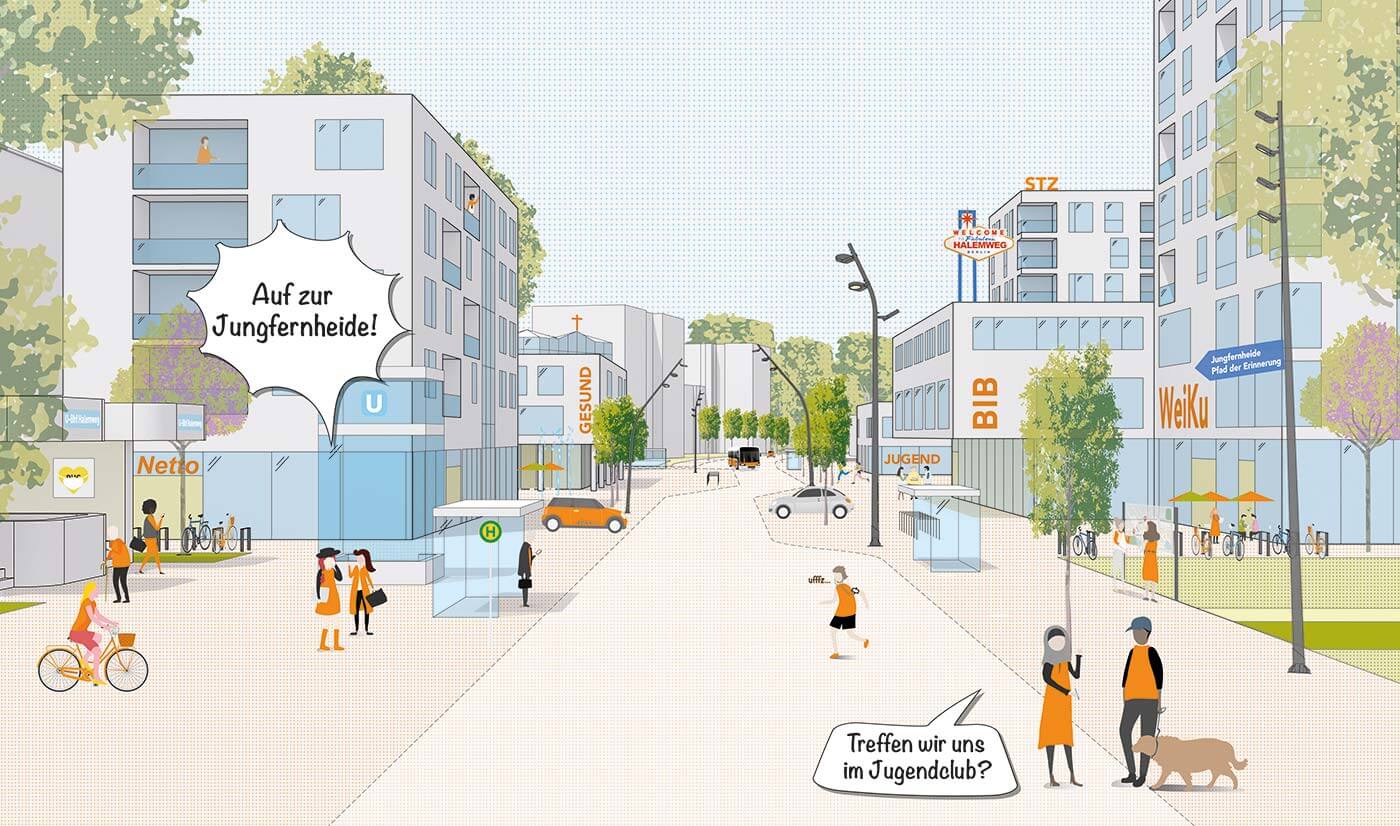
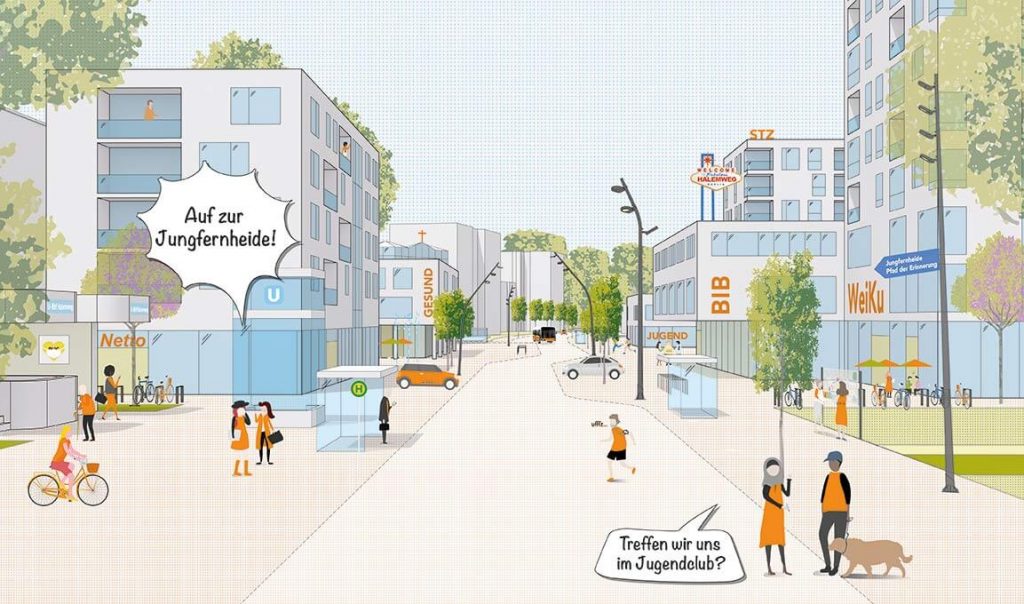
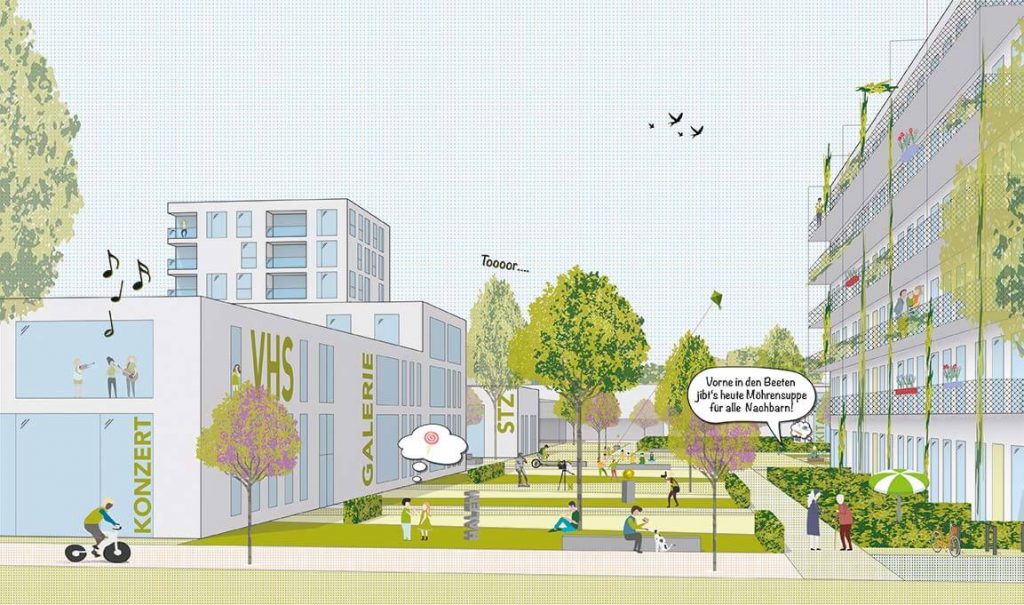
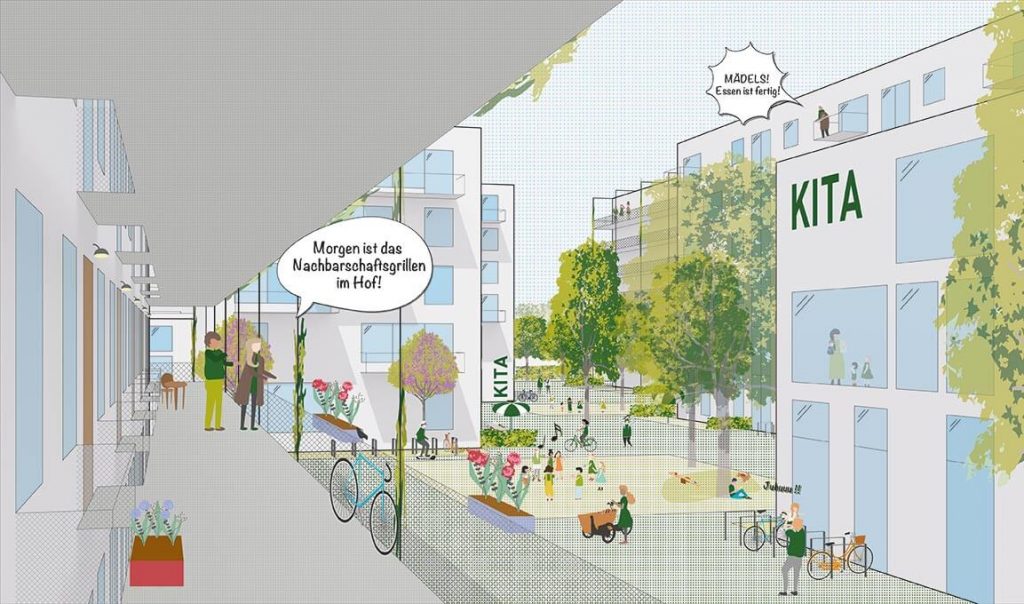
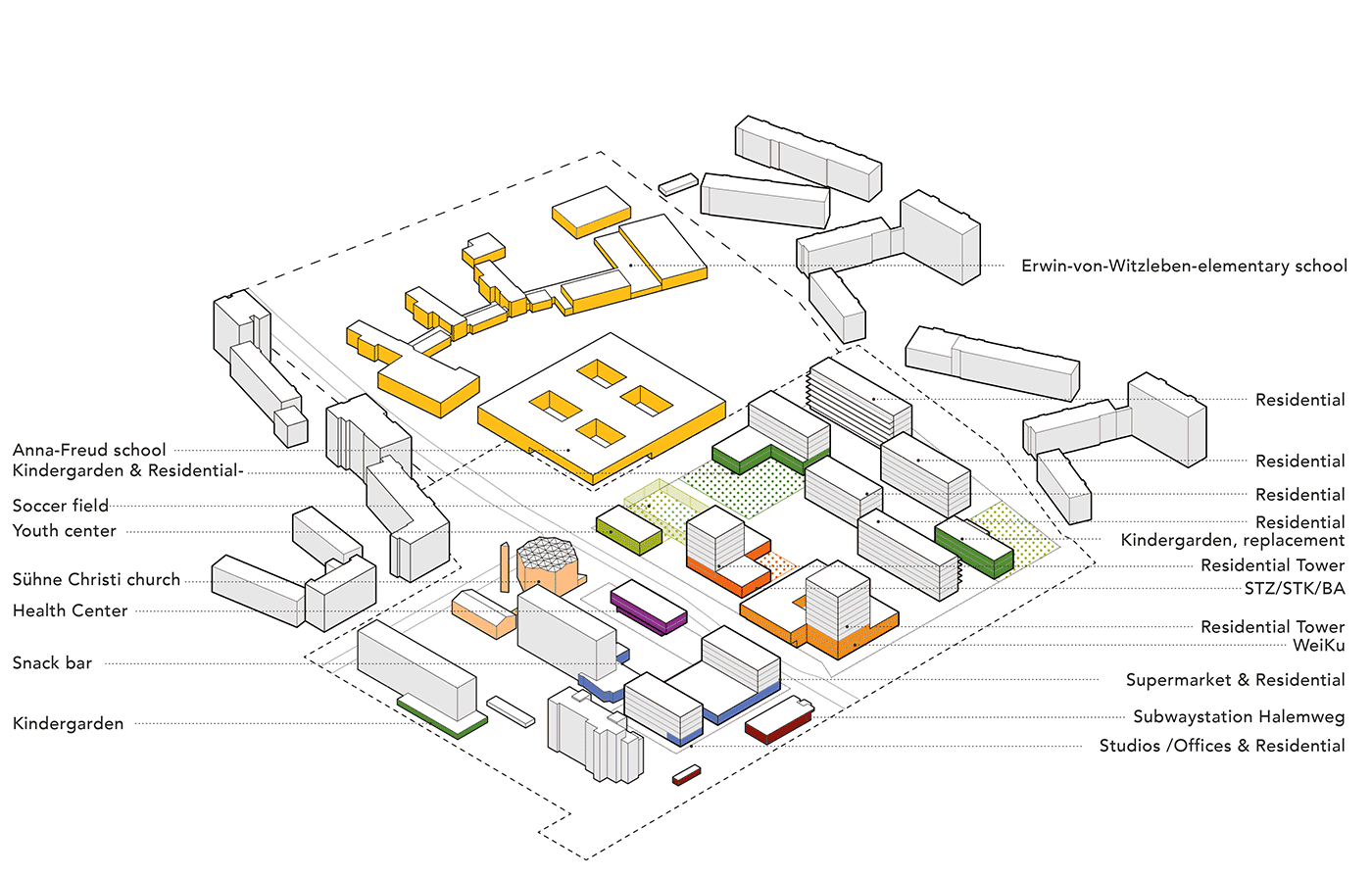
The street is a room by agreement… a community room dedicated to the city for common use… its ceiling is the sky.” (Louis Kahn 1959) – The new road Halemweg is a street conceived in this spirit and will form the central spine for a series of communal spaces and public buildings. It connects the U-Bahn and the Jungfernheide public park and serves to integrate the neighbourhoods.
The Halemweg works as a linear artery that connects surrounding areas, joins up the old and the new, creates flexible, multi-use spaces and develops further the modern ideal of a green urban landscape for relaxation while at the same time organising the distribution of open areas. Separation of the various modes of transport is done away with in favour of a shared space. The Halemweg becomes an effective linear sequence for circulation and movement, while also providing high-quality accommodation and places for communal activities. Coming out of the underground station, one cannot but admire the vital green space of the Jungfernheide park on the horizon.
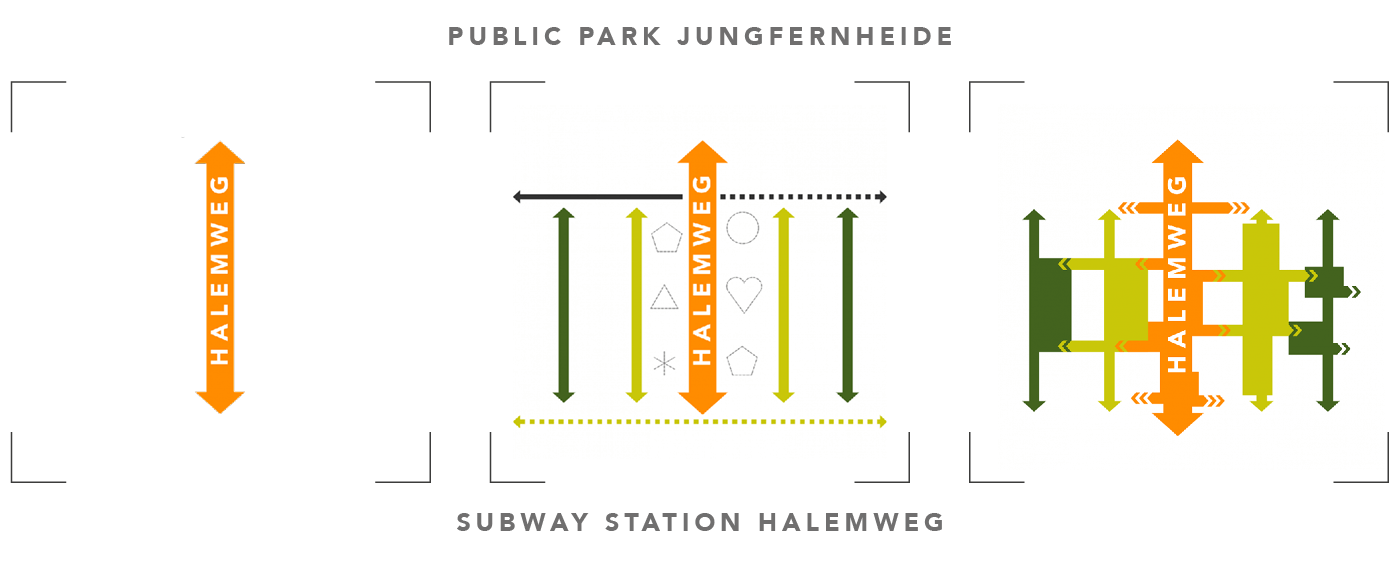
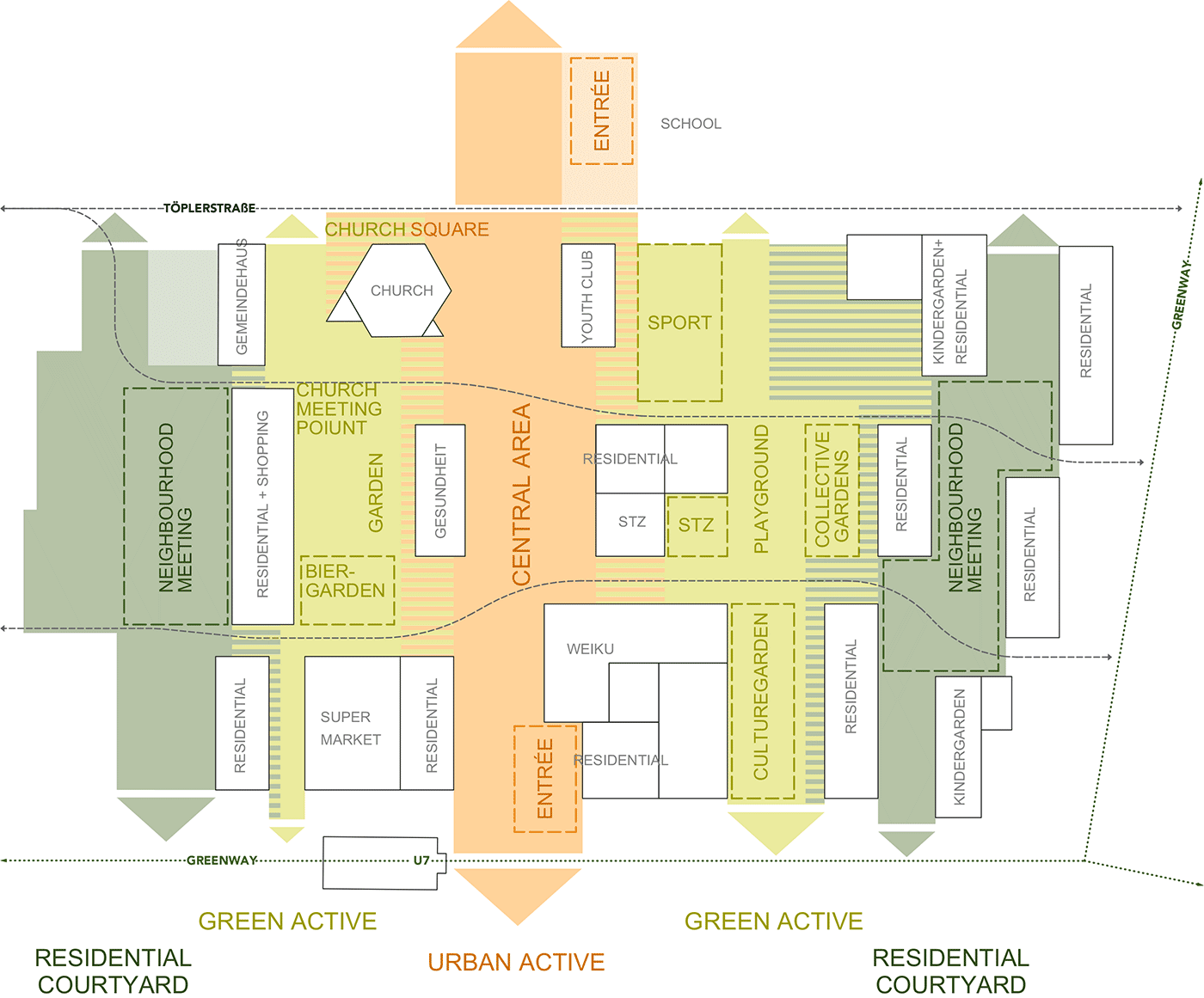
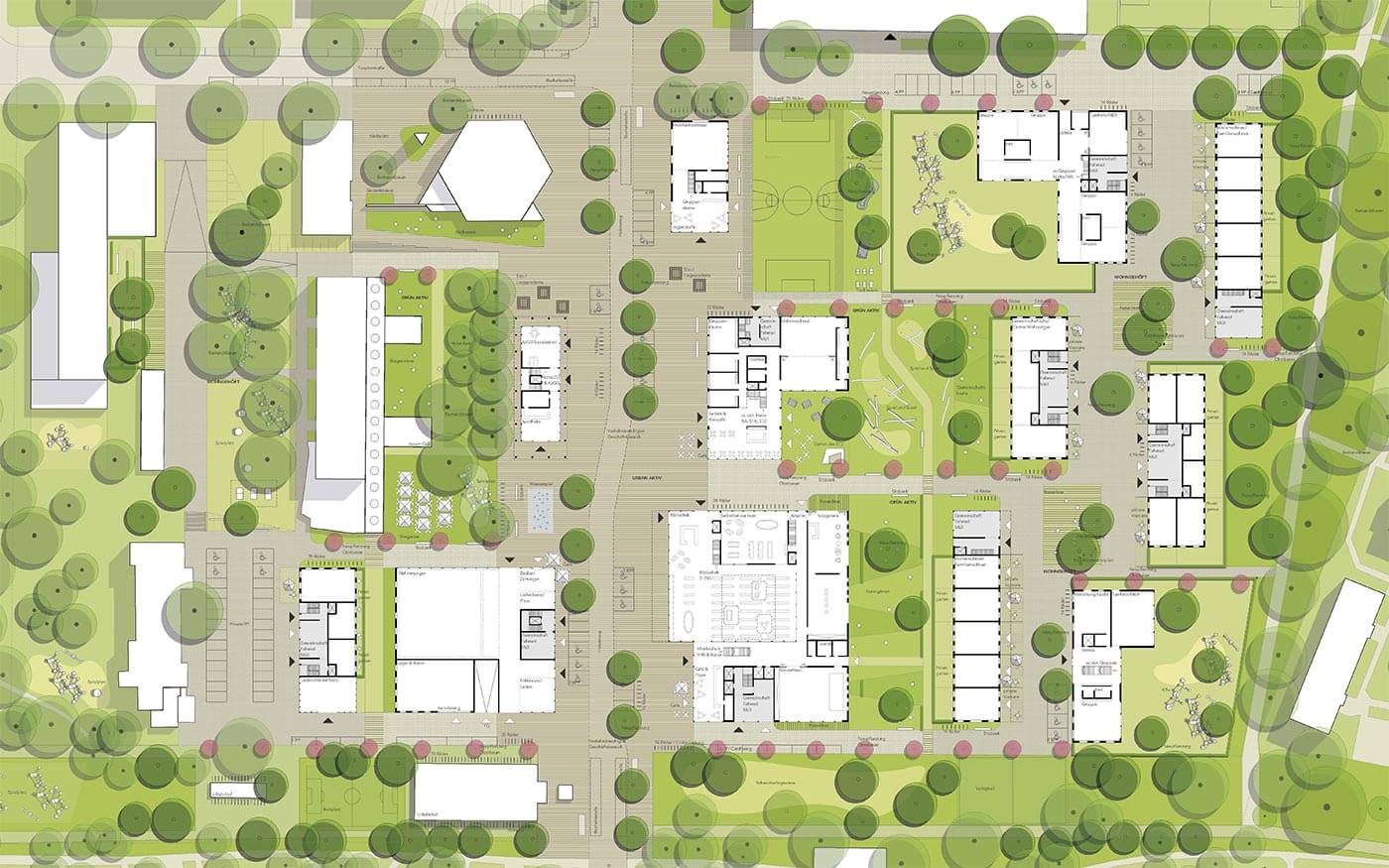
The urban space network is a means of organising public areas, creating important pathways and defining uses. Addresses for both new and existing buildings are formed. The basic elements of the spatial network are three areas with different programming, oriented in a North-South direction. Behind this structural approach lies the fundamental concept of “urban lightness”, which aims to further develop and reinterpret modern urban planning without resorting to the typical Berlin block structure.


Competing Urban Planning Appraisal Procedure, 1st price


Program: Concept for a community center,  7 ha

Location: Charlottenburg-North, Berlin, GER

Year: 2019-2020

Client: City of Berlin

Team: Therese Granberg, Joachim Schultz-Granberg, Anna Beckmann, Daniel Heuermann, Yannick Schulze, Anna Nötzel

Partner: bbz landscape berlin


SSS-Diagramms Halemweg-en


Urban Space Network


Site plan


related projects
Town Hall Lippstadt (DE)


City of Gardens


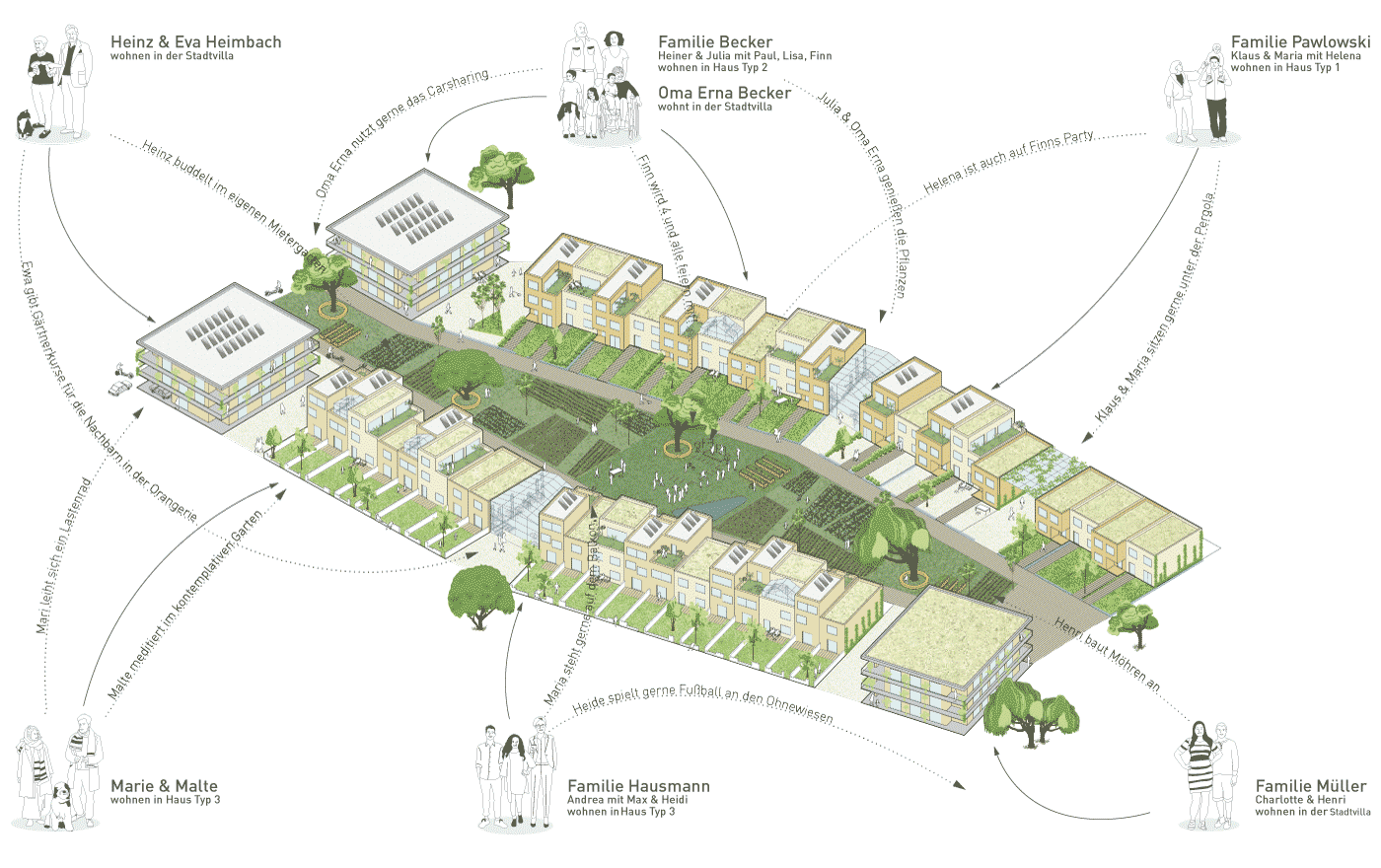
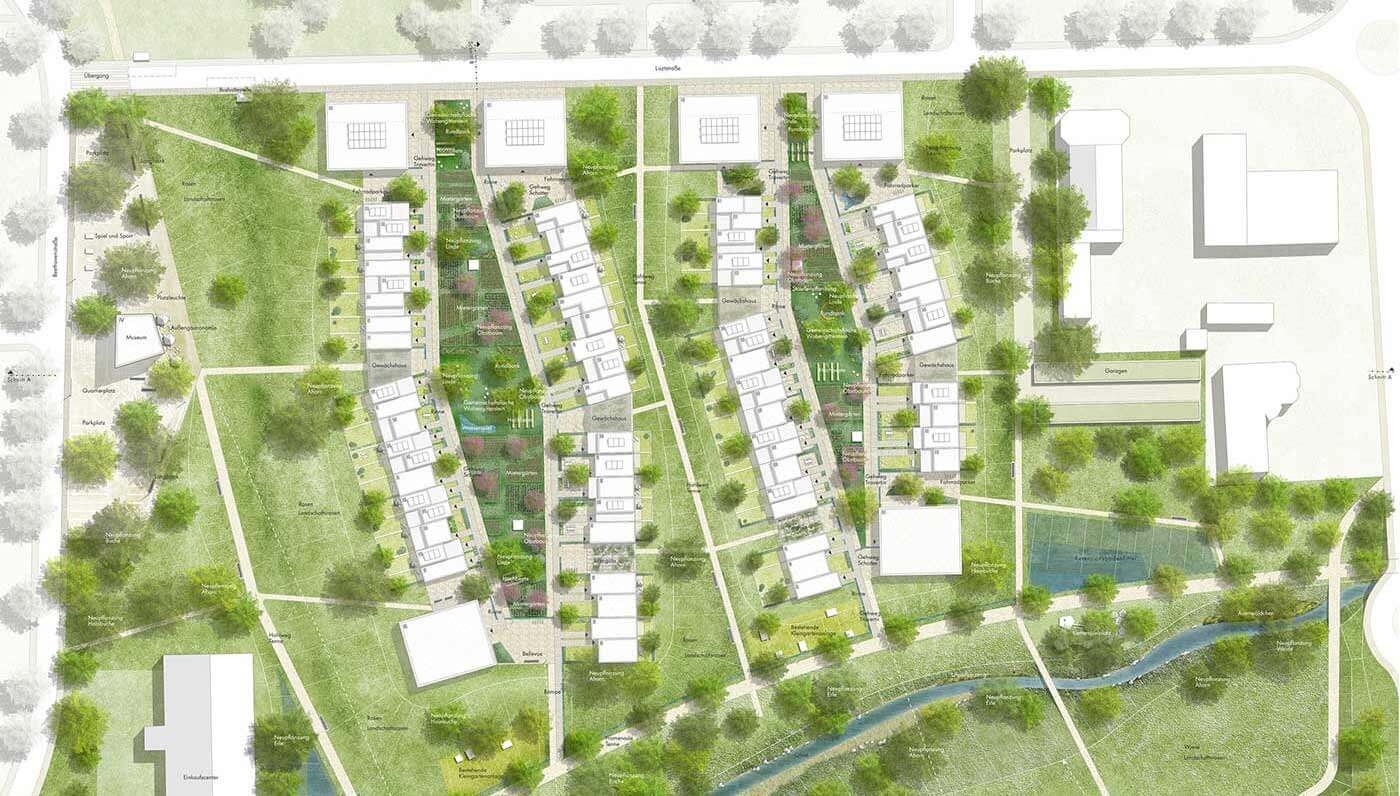
A balanced relationship between private space and communal areas is the basis for stable and sustainable neighbourhoods. The City of Gardens allows each apartment access to a wide variety of open spaces and offers a multi-faceted interface between home and landscape.

The planned State Garden Show 2024 pursues the theme of “reconciliation between city and landscape” and redevelops the concept of the garden city. The project investigates urban-rural topologies, the interface between interior and exterior space, typological innovations and new role models for contemporary urban patterns.

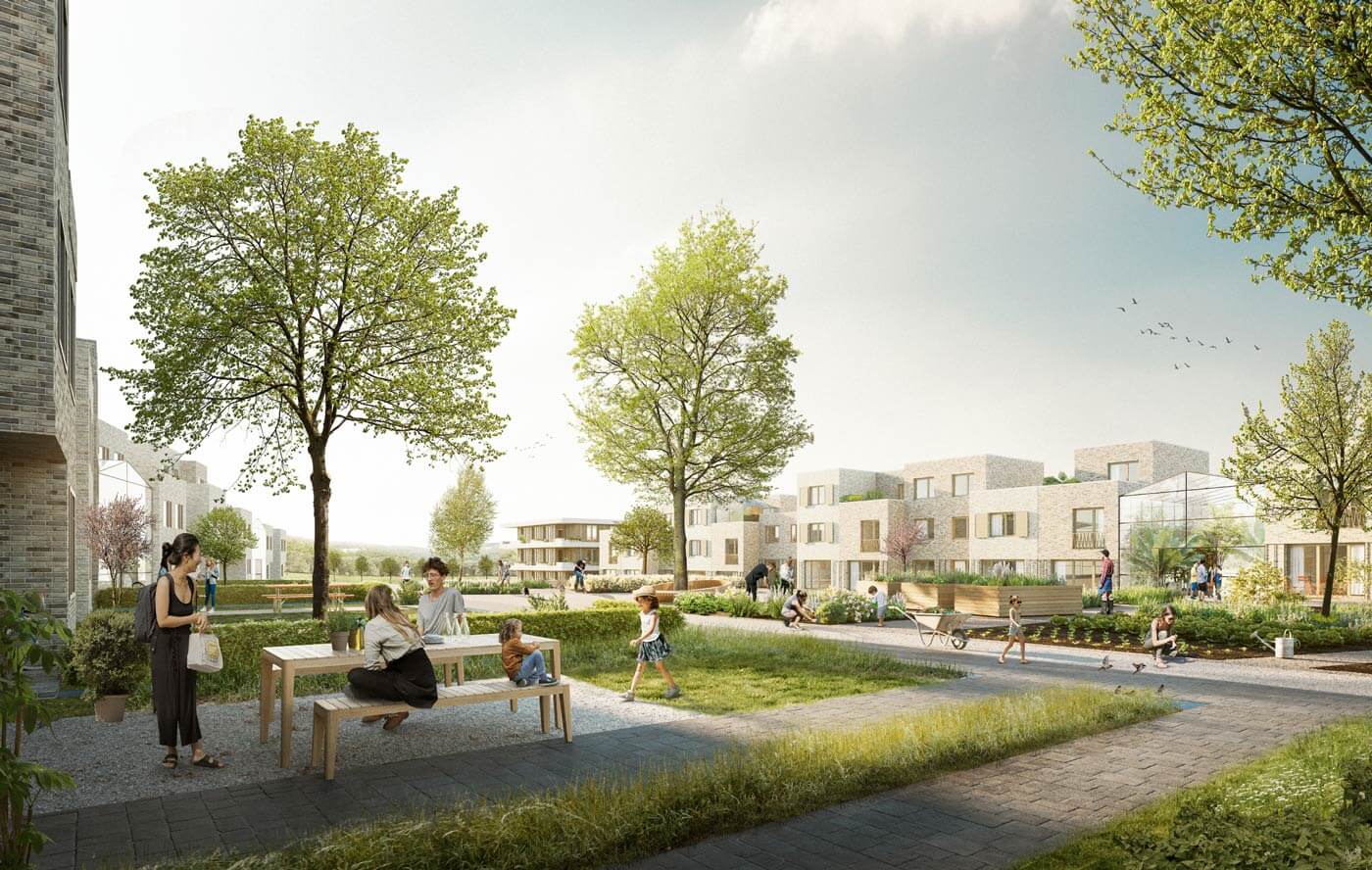
The variety of life styles is reflected in the diversity of apartment types and their potential for active neighbourhoods. The garden city becomes the city of gardens. Here, families with and without children, those who are single and couples, both active and less active seniors all find an appropriate housing model and fitting green spaces: balconies, (roof) terraces, front gardens, enclosed green spaces for quiet contemplation, neighbourhood orangeries, allotments and areas for urban gardening.

Courtyard-size commons are created by the erection of buildings. At their southern end, slightly elevated terraces open up the view towards the river meadow. The rows of terraced houses are interspersed with breathing spaces, green living rooms, which are configured to suit individual tastes and needs. The house entrances face the courtyard, promoting neighbourly relations and friendly social interaction.


Competition


Program: State Garden Show with New District Development, 15 ha

Location: Leinefelde, Thuringia, GER

Year: 2020

Client: City of Leinefelde-Worbis

Team: Therese Granberg, Joachim Schultz-Granberg, Anna Nötzel, Daniel Heuermann, Eyal Perez

Partner: bbz landscape berlin, DMSW architecture


SSG-Leinefelde-Commoning

Central Common


Siteplan


related projects
(Sub)urban Mix, Limburg


Town Hall

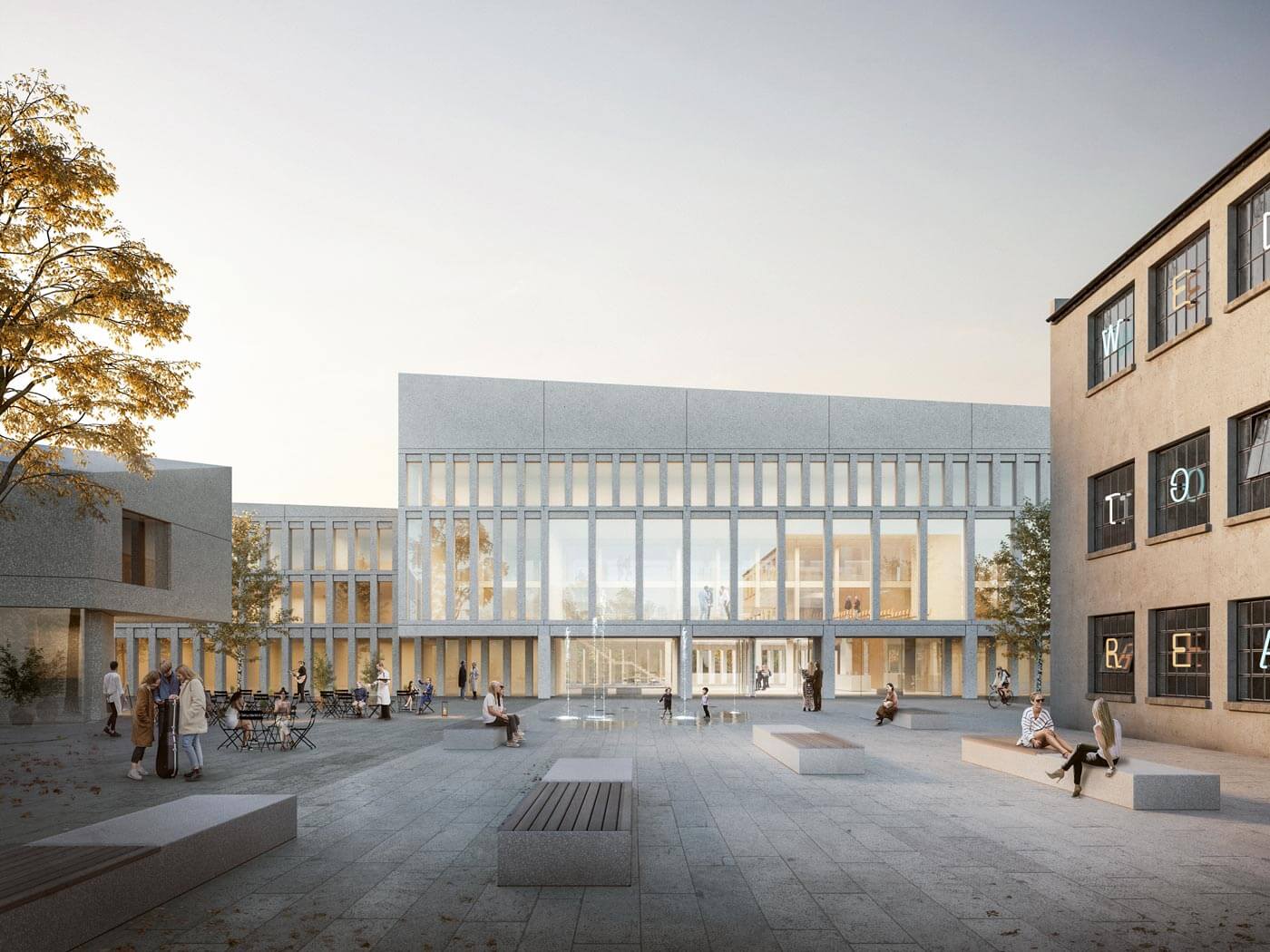
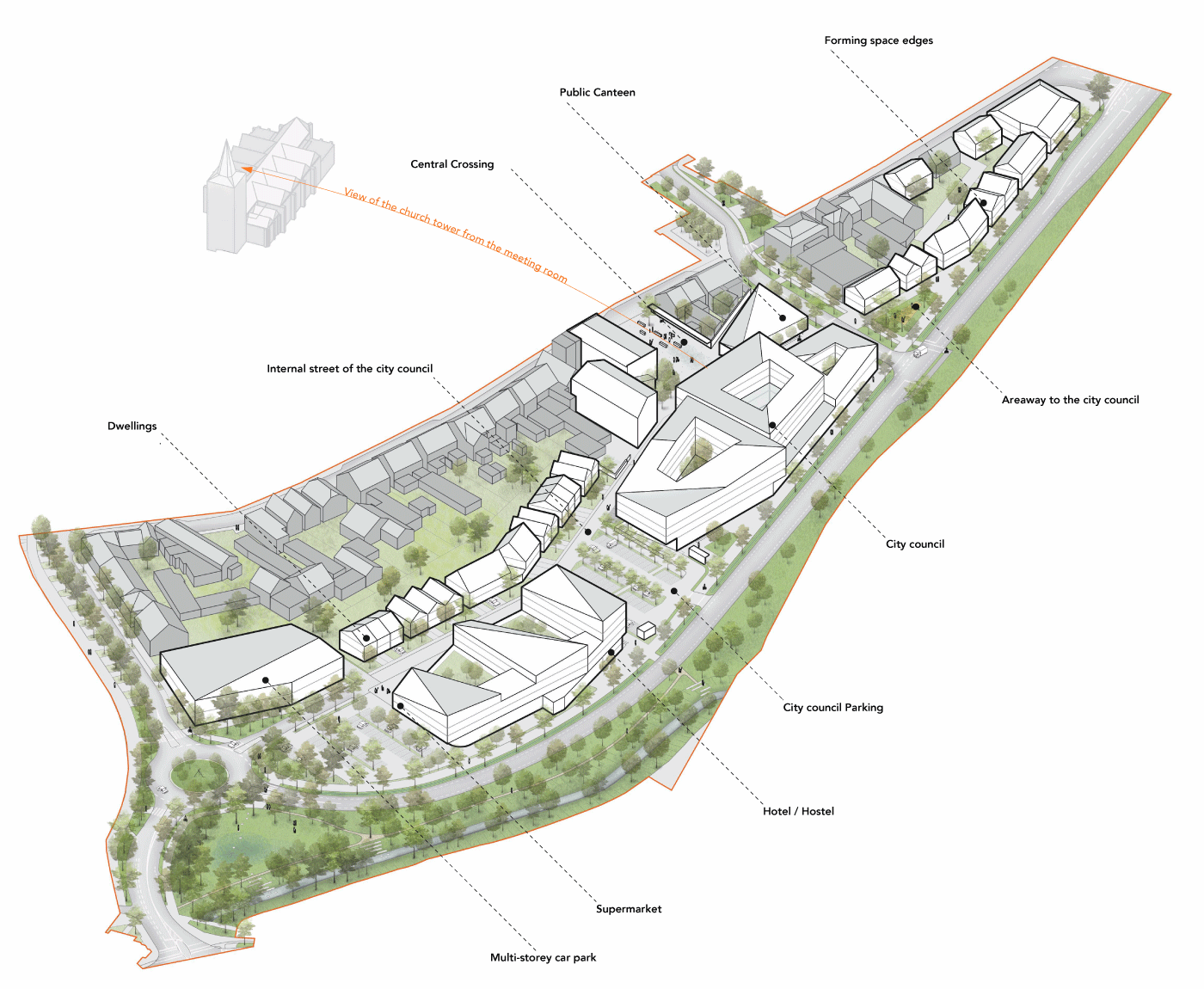
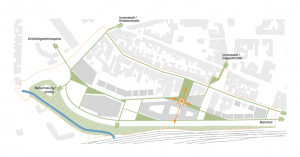
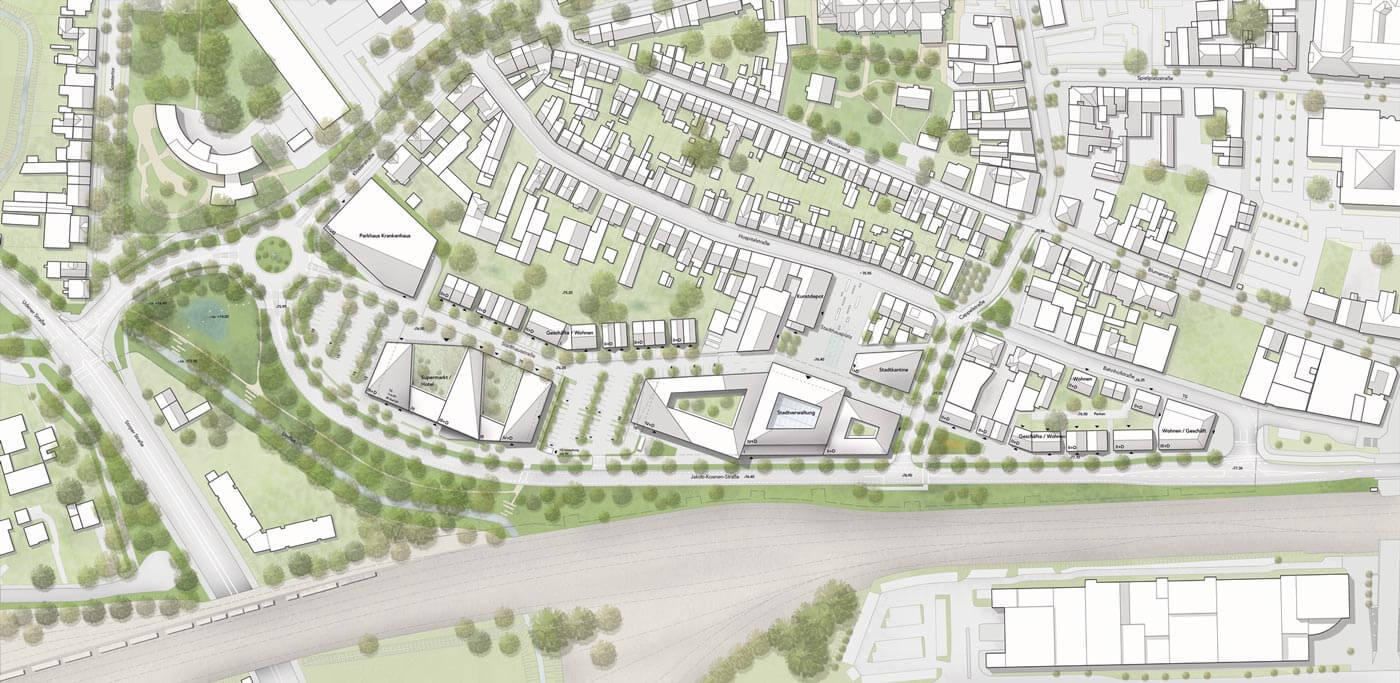
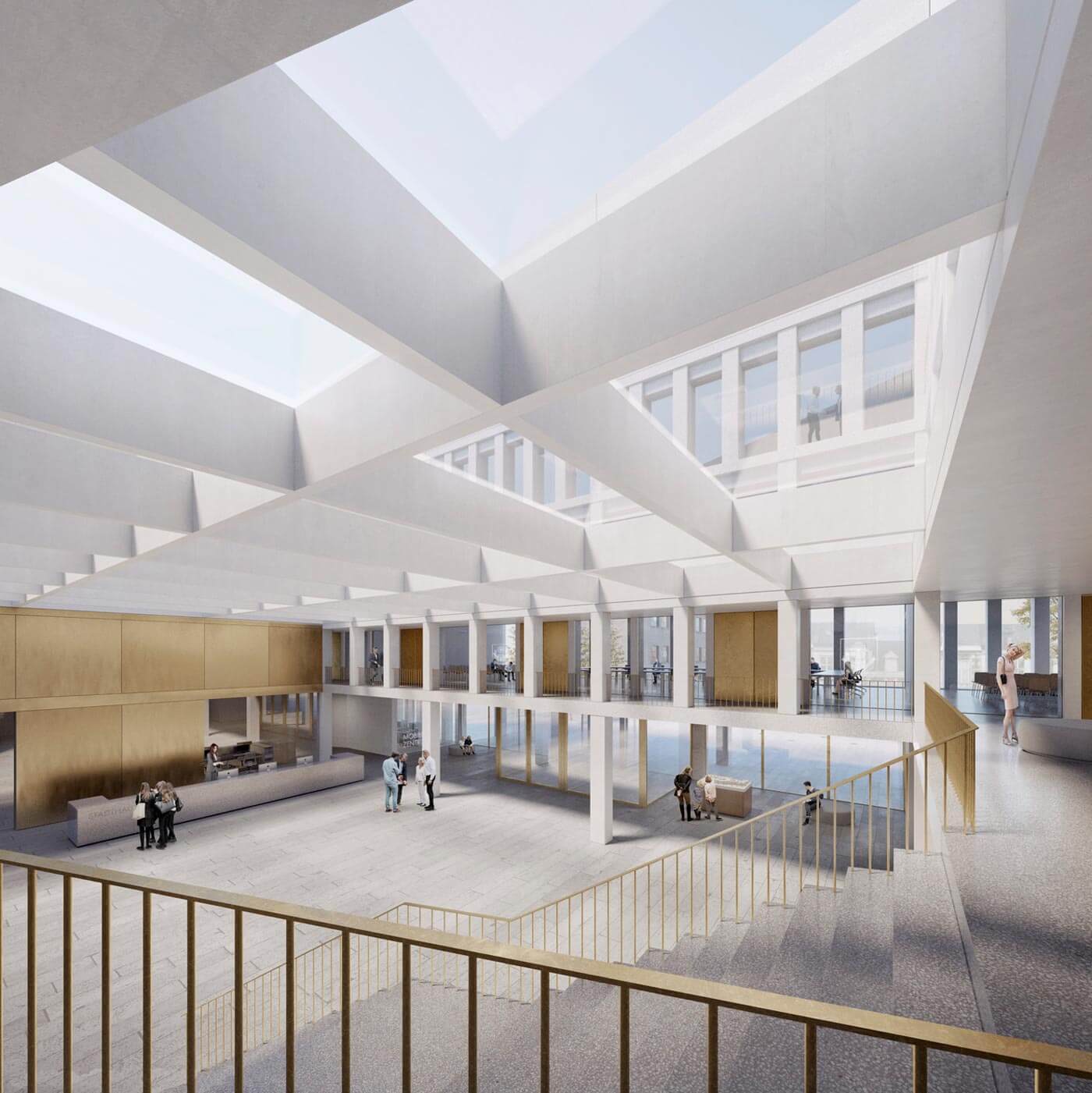
The new city council forms the central anchor point of the area and seeks the closest possible proximity to the railway station and the city. The location in the eastern part of the site not only shortens the distances to the other public buildings, but also offers the opportunity for a new urban quarter favouring pedestrians and cyclists.

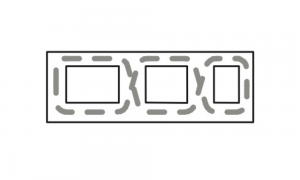
The required programme for the entire quarter is being accommodated in three independent building volumes. The city council, the food market with mixed uses and the multi-storey car park for the Trinity Hospital form a coherent ensemble visual from the southern railway.

The space between the buildings offers places to linger, room for pedestrians and cyclists and motorised access. In addition, a public canteen at the main entrance of the city council, which completes the eastern edge of the newly created “Stadthausplatz” is proposed. An important public crossroad, surrounded by the restored museum depot, the new city canteen and the open foyer of the city council, is formed. The square functions as a meeting point, offers space for water games on warm summer days and can be used as a place for public screenings.


Realization competition, 1st prize


Program: City council with surrounding neighbourhood, 7 ha

Location: Lippstadt, DE

Year: 2019

Client: Stadt Lippstadt

Team: Therese Granberg, Joachim Schultz-Granberg, Daniel Heuermann, Anna Beckmann

Partner: Heimspiel Architekten, Planergruppe Oberhausen


mobility

rainwater management

program

pedestrian network


Siteplan


The self-similar formal language of the volumes in the site plan and the shape of the fractional roof landscapes can be read as a continuous theme and promote the unity of the ensemble. The new city council and the food market respond to the existing large-scale buildings in the south and form an emblematic address to the railway embankment. To better correspond with the small-scale character of the old town in the north the buildings are fragmented by projections and recesses in the façade and by the inclined roof landscape.


(Sub)urban Mix

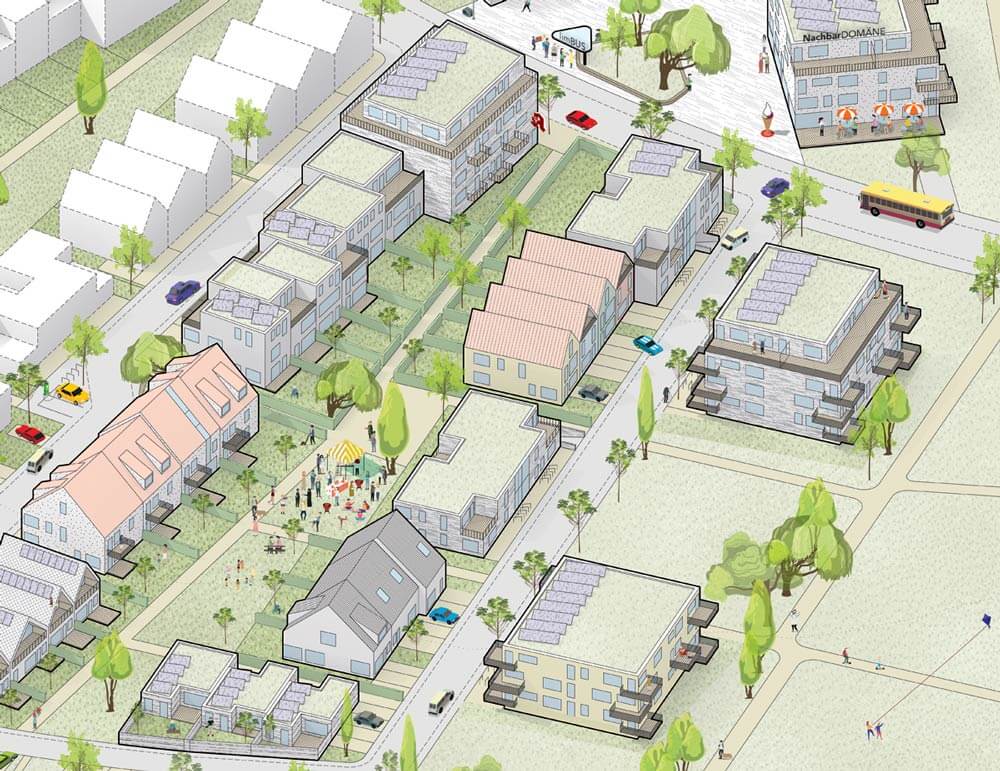
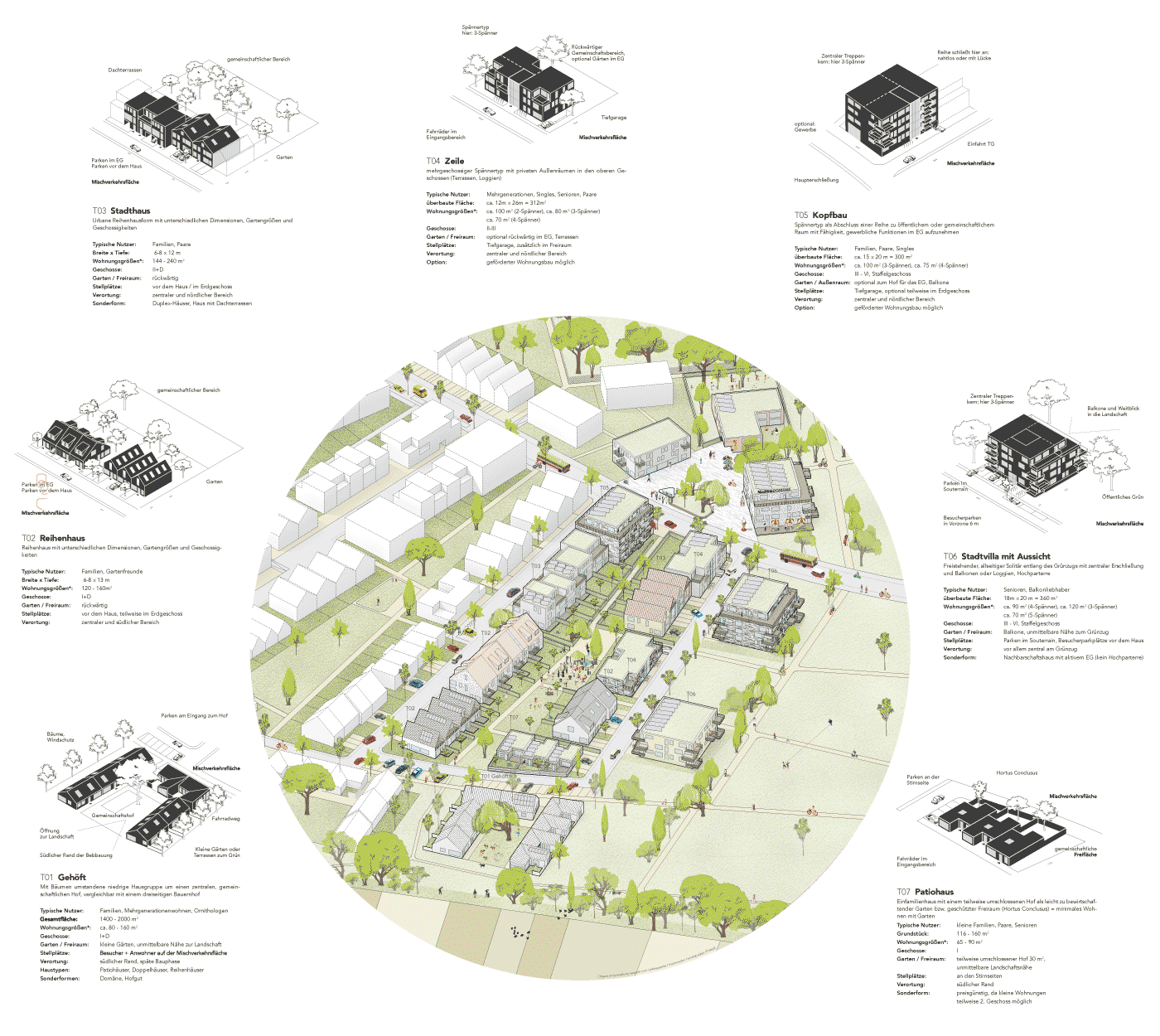
The (sub)urban mix provides a diverse housing offer for all stages of life, a mix of different typologies from the almost urban to rural buildings carefully integrated into the landscape. Each plot offers a differentiated range of housing and a variable proportion of communal open spaces.

For years, criticism of monotonous single-family housing areas has been mounting: expensive energy upgrades often accelerate their decline in value and their conversion to more accessible dwellings are complicated for aging owners who therefore opt to purchase expensive barrier-free properties. These are clear indicators that single-family properties are generally ideal only for young households with children. At the same time, the population of over 60s in Limburg is increasing significantly. Blumenrod’s future development is therefore not only limited to detached dwellings, but also offers a wide range of housing options tailored to the differing needs of the population which in turn promotes community development within the framework of a manageable, small-scale mix.

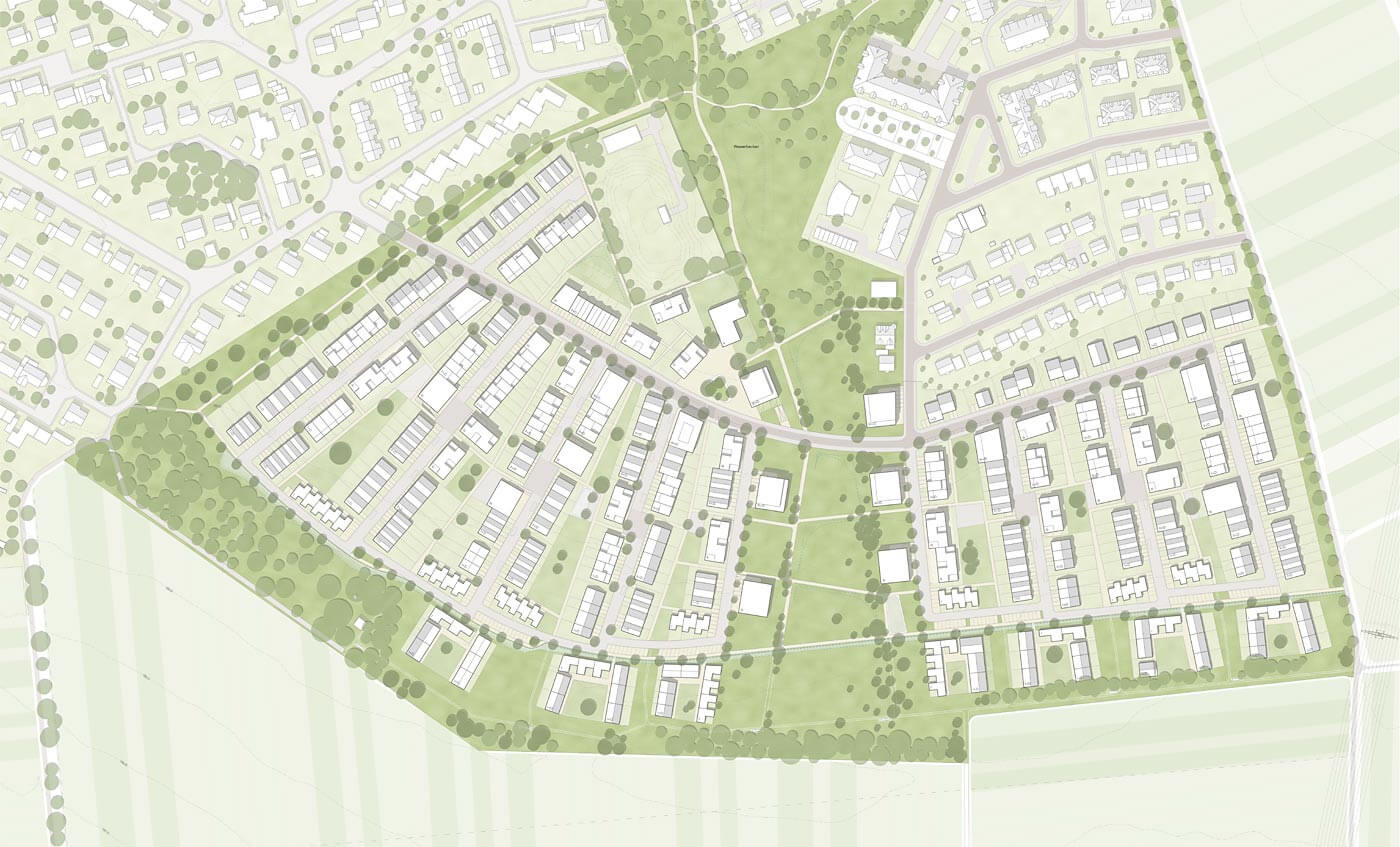
The central green corridor present in the area seamlessly expands the existing ‘Stadtpark Blumenrod’. This forms an up-market open space for both old and new residents. The continuation of the existing green corridor south of ‘An der Landstraße’ allows walks out of Blumenrod into the adjacent countryside. The city park and its foothills can be reached with a maximum walking distance of 150 m from any plot in the new building area. Based on the logic of efficient connection to the existing road network, seven central plots and adjacent peripheral areas are being developed. This basic urban fabric forms a clever, compact and robust network of short walkways and is the foundation for a diverse residential area.


Competition, 1st prize


Programme: Housing and residential use, 25 ha

Location: Limburg-Blumenrod, (GER)

Year: 2019-2020

Client: Stadt Limburg

Team: Therese Granberg, Joachim Schultz-Granberg, Tobias Birkefeld, Daniel Heuermann

Partner: häfner jiménez betcke jarosch landschaftsarchitektur, Mathias Uhl


SSG Limburg Lageplan


SSG Limburg Typologien

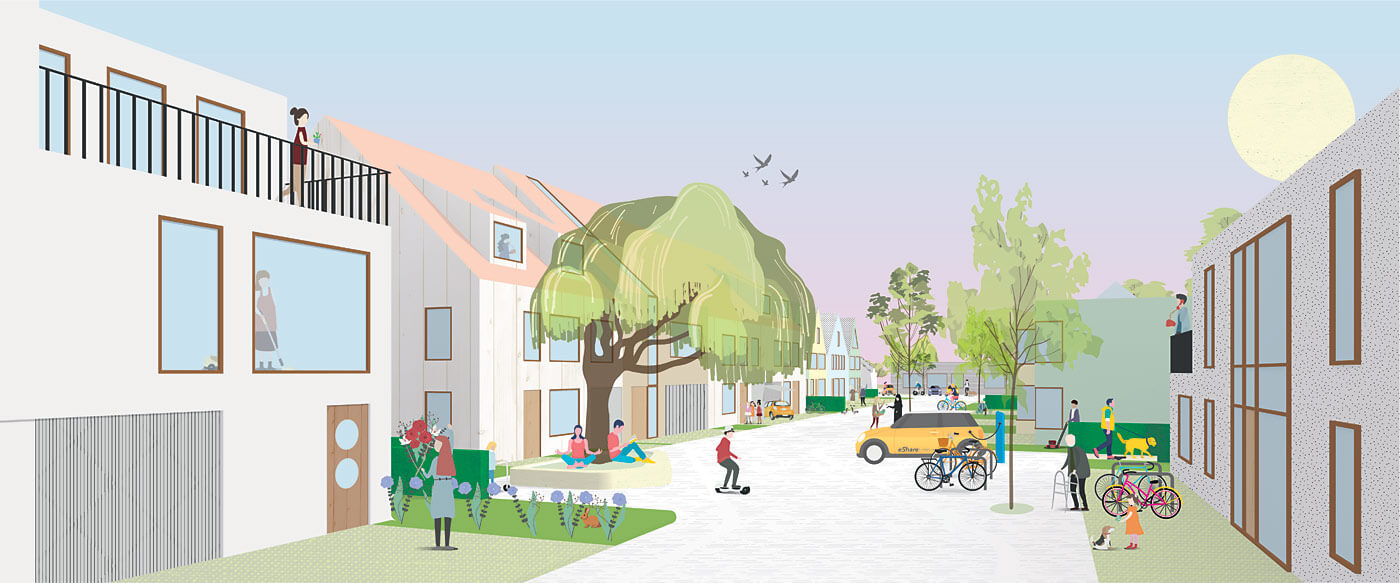
SSG Limburg Perspective


related projects
Green Loop, Greven

Oxford Barracks

Valuable building stock from the 1930s offers the potential for conversion into a high quality residential district: A combined strategy featuring adaptation, removal of coverage, demolition, addition and new construction deals with historic strata in a respectful way and forms new ones for a sustainable district and its projected 3000 inhabitants. The slightly sloping topography provides the opportunity for a cascading rainwater harvesting system. As result, the degree of alteration of the natural water balance through development is kept as low as possible

Existing buildings, fragments and traces are the point of origin for the future and sustainable development of the Oxford Barracks. New buildings are sited carefully and set into relation with the existing structures. The existing urban design image is maintained as far as possible, particularly along the main axis in the area of the former drill ground. It offers views towards the sequence of the barracks structures and the clock tower. Partial areas can be protected if necessary to preserve elements of the overall urban design. In other areas additions can take place in a flexible manner in order to meet the requirements of a sustainable and vibrant residential district: the aim is diversity instead of monoculture.

The former main axis of the casern becomes a green boulevard. The existing paving follows the new streetscape and is thus preserved as a historic stratum while becoming a space for public life. Infiltration trenches and kiosks are situated here. The boulevard widens into a “green funnel” uphill and graciously connects to the existing open space and expresses the interweaving of program and space.


Masterplan Conversion + Guidelines Design >>


Programme: approx. 1200 apartments on 27 ha

Sustainability: DGNB Pre-Check ‘Sustainable Urban Development’: Label ‘GOLD P/O Consulting Ingrid Pohl >>

Location: Münster, (GER)

Year: 2014 – 2017

Client: City of Münster

Team: Joachim Schultz-Granberg, Therese Granberg, Jan Bockholt, Martin Dennemark, Tobias Grothues, Phatarapol Jampa

Partners: Kéré Architecture, bbz landschaftsarchitekten berlin, Prof. Mathias Uhl


siteplan

rainwater management


Oxford Kaserne WSUD

Siteplan and rainwater management (detail)


residential courtyard

central square

related projects
design guidelines Oxford-Barracks
conversion Meerbusch-Osterath